


Poetic brushwork relates a narrative










In August 1502, 75-year-old Shen Zhou, a cultural icon and painting-calligraphy master based in today's Suzhou city, eastern China's Jiangsu province, lost his eldest son to disease. Three years later in the spring of 1505, an anguished Shen, who called himself "a wretched old tree with nothing for support", composed a number of poems — 30 to be exact — and collectively titled them Poetry of the Fallen Flower.
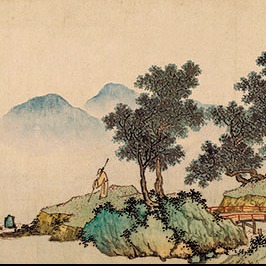
Probably still feeling inconsolable, the old man then started to paint, in the same vein as he did the poems. The result, which shows a solitary Shen standing on a big rock, leaning against his cane and looking into the afar, is inscribed with his own words: "The mountains stand empty, no soul in sight; water flows as blossoms fall."
The work is now on view at the Nanjing Museum, part of an exhibition focusing on the artistic influence of Su Shi (1037-1101), a Northern Song Dynasty (960-1127) polymath who's equally great at poetry and prose, painting and calligraphy.
"By saying that painting could be just as cathartic a process as poetry-writing, Su effectively fostered mutual inspiration between the two," says Pang Ou, the exhibition curator.
"By the time of Shen, it had become almost standard practice for a literati painter like him to paint under the admitted influence of a piece of writing, be that writing from himself or someone else."
Given Shen's esteemed status within his circle of friends, it was no surprise that many more poems elegizing the fallen flowers were composed, and paintings done, by others who felt compelled to respond in their own way.
"In that sense, Su Shi had made painting a crucial way for educated members of ancient Chinese society to communicate on paper, something they had previously been doing almost exclusively through poetry," the curator says.
"It also made possible the mining by literati painters of all poems written throughout Chinese history, including those from the great poets of the Tang Dynasty (618-907)."
Those who had struck a particularly deep chord with the literati painters are farewell poems, of which Su had written more than a few. "An old man bids farewell to his parting friends by the water's edge, where the sandy shore bears the traces of horse hooves," goes one of Su's farewell poems.
Another person who felt old — and disillusioned — was Wen Zhengming (1470-1559), a protege and close friend of Shen who commanded a big following of his own as a much-emulated painter-calligrapher.