



More incentives needed to make coal mines greener









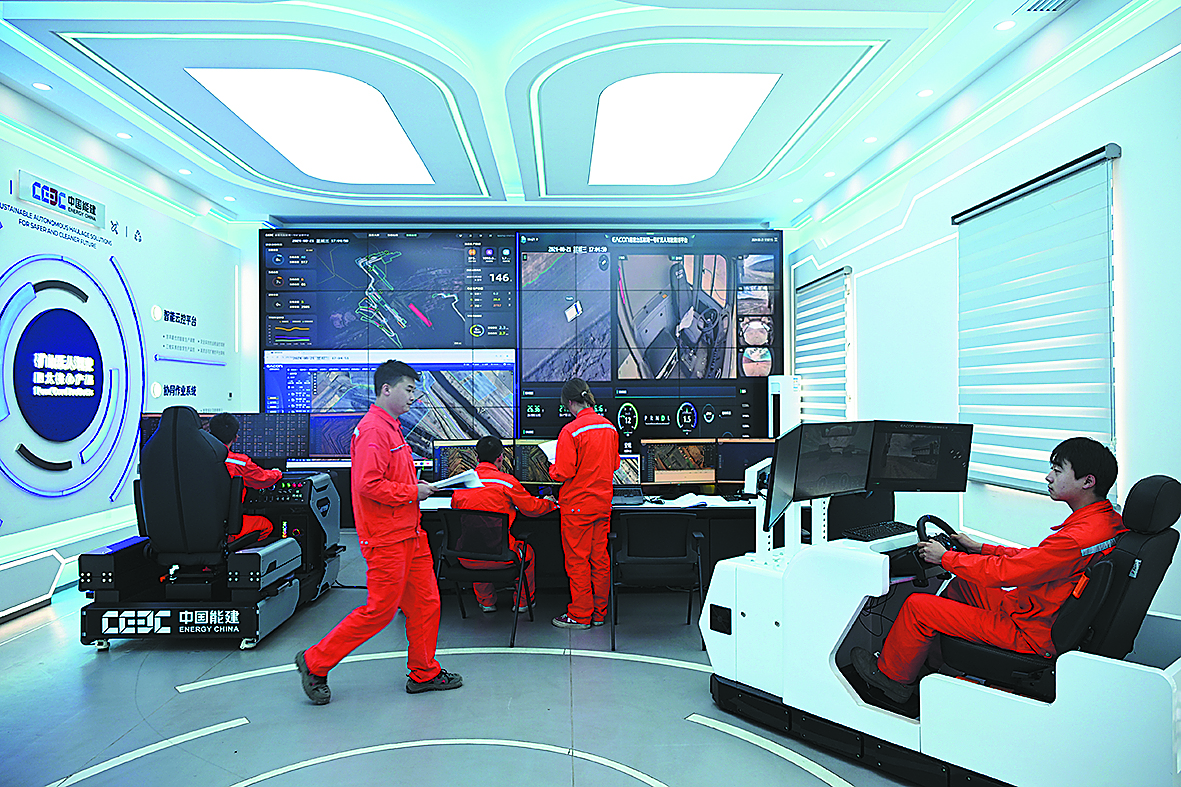
As China intensifies efforts to reduce methane emissions from coal mines, industry insiders are calling for mandatory extraction and utilization of low-concentration coal-bed methane, along with more incentives for its utilization.
Since initiating coal-bed methane extraction during the 11th Five-Year Plan (2006-10) period, China has made significant strides in this area.
In 2015, the country extracted roughly 13.6 billion cubic meters of the resource, with a utilization rate of about 35.3 percent, according to the National Energy Administration.
Extraction reached around 13 billion cubic meters in 2022, with the utilization rate climbing to approximately 45 percent, Liu Wenge, deputy head of the Ministry of Emergency Management's Information Institute was quoted as saying in a recent report by China Energy News.
Methane is more efficient at trapping heat than carbon dioxide. It is over 80 times more potent than CO2 over the first 20 years after reaching the atmosphere. On a 100-year time scale, it has 28 times greater global warming potential.
Approximately 40 percent of China's methane emissions stem from escaping gas during coal mining, making the sector a critical battleground for efforts to enhance control of the potent heat-trapping gas.
While utilizing coal-bed methane with a concentration exceeding 8 percent is economically and technologically feasible, it's not the case for the resource with lower concentrations, said Yan Heng, head of the production technology department at Shanxi Jinju Coal Electrification Co.
Coal-bed methane with a concentration exceeding 30 percent is finding its way into everyday applications — domestic consumption, and powering buses and taxis, Yan said. Coal-bed methane with a concentration of 8 to 30 percent can be used for power generation, which also proves profitable.
Yan highlighted the need for technological advancements and policy support to promote the use of the resource with lower concentration.
"Its utilization for power generation is costly with low returns," Yan said, noting that without mandatory controls, coal mines often discharge low-concentration methane directly to minimize costs.
Despite the challenges, China's potential for utilizing low-concentration coal-bed methane is vast.
Ventilation air methane, which has a methane concentration of about 0.75 percent, accounts for 81 percent of the total methane in the country's coal mines, according to China Energy News.
The methane emitted every year at coal mines across China is equivalent to the annual gas transported via the country's huge west-east gas transmission project, the news outlet said. The greenhouse effects generated by the emission are substantial, equating to roughly 200 million tons of CO2.
Shanxi Jinju Coal Electrification Co has called for greater incentives to encourage the utilization of low-concentration coal-bed methane considering its low returns but high environmental benefits.
The call has been echoed by the Institute for Global Decarbonization Progress, a nonprofit think tank with offices in China and Europe.
Currently, incentives for coal-bed methane utilization across the country are provided without considering the differences in methane concentration, and thus fail to effectively motivate the utilization of the resource with low density, it said in a recent report.
The think tank has also called for the government to tap the potential of the China Certified Emission Reduction program, a voluntary mechanism in which participants can earn carbon credits to trade by taking actions for carbon emission reduction, in encouraging the use of the low-concentration resource.
The Ministry of Ecology and Environment made public in October last year methodologies for quantifying net emission reductions or removals for four types of projects: forestation, solar thermal power, offshore wind power generation and mangrove revegetation.
According to Xu Huaqing, chief scientist with the National Center for Climate Change Strategy and International Cooperation, the center is supporting the ministry's department of climate change to proactively advance the establishment of the CCER methodology for coal-bed methane utilization.
"Hopefully, the next batch of methodologies to be published may include the voluntary emission reduction from coal-bed methane utilization," he said.


- China to curb 'one-size-fits-all' law enforcement on factory ventilation
- El Nino likely to form in coming months, raise global heat risk
- China's reading rate rises amid digital reading boom: survey
- China launches national reading week
- The train expert you don't know you need
- Nobel laureate delivers lecture on attosecond light pulses in Shanghai





