


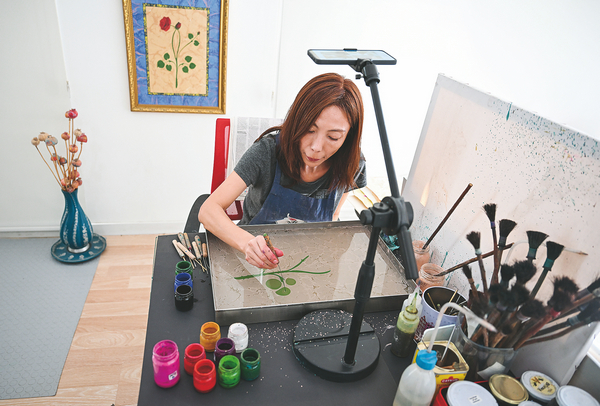
ISTANBUL — Li Xintong's journey with Ebru, the ancient Turkish art of paper marbling, began in 2007 when she moved from the northwestern Chinese city of Xi'an in Shaanxi province to Istanbul, Turkiye.
Captivated by its beauty after first seeing it on TV, she decided to pursue the art and enrolled in lessons in Turkiye. After seven years of dedicated study, Li earned her master's certificate in Ebru and started incorporating Chinese elements, such as traditional clothing and characters, into her work, creating a unique fusion of both cultures.
"As you delve deeper into the art, you realize it is far more complex than it first appears," Li explains during an interview in her atelier.
To create an Ebru, artists, in the first step, carefully sprinkle and brush natural pigments onto oily water to produce vibrant and swirling patterns and then transfer the patterns onto paper or fabric.
Yavuz Tiryaki, a renowned Turkish Ebru master and writer, says that mastering this ancient craft requires years of study, training and a deep connection to traditional methods.
He explains that the intricate patterns of Ebru art can only be created using natural materials, such as ox-gall obtained from the gall bladder of an animal, which has been used for nearly 500 years.
Also, Li says that "the preparation and viscosity of the aqueous solution, along with the mixing and brewing of the pigments — which account for 70 to 80 percent of this craft — are particularly challenging".
Historians believe Ebru originated in the East and was brought to Turkiye via the ancient Silk Road during the Ottoman era. It has been passed down through generations and is officially listed as a UNESCO world intangible cultural heritage.
After mastering the art in Turkiye, Li frequently travels back to China, offering workshops and online classes to Chinese enthusiasts, fostering cultural exchanges and sharing her expertise.
The growing interest in her works has also drawn the attention of Turkish media. Li has been invited to showcase her unique creations to the Turkish public.

"I made several adjustments, incorporating elements such as a Chinese silk fan, a delicate silk scarf, a small parasol, and a miniature paper umbrella," she says, adding that "Turkish audiences found these Chinese elements charming and beautiful, often calling in to express their admiration".
Li's dedication to the art form has been recognized by her teacher, Erol Caglar, a leading expert in Ebru with over 20 years of experience, who has witnessed her passion and commitment over the years.
"I have students from China and other countries, and I can say that the most dedicated are my Chinese students," Caglar says.
"Li's deep fascination with Ebru is evident in her unwavering dedication over the years. She has remained passionately committed to mastering and evolving the art," he adds.
Xinhua








