


Carving out a symbol of virtue
Craftsmen deploy their skill and experience accumulated over the centuries to help shape jade's continuing appeal, Fang Aiqing reports.










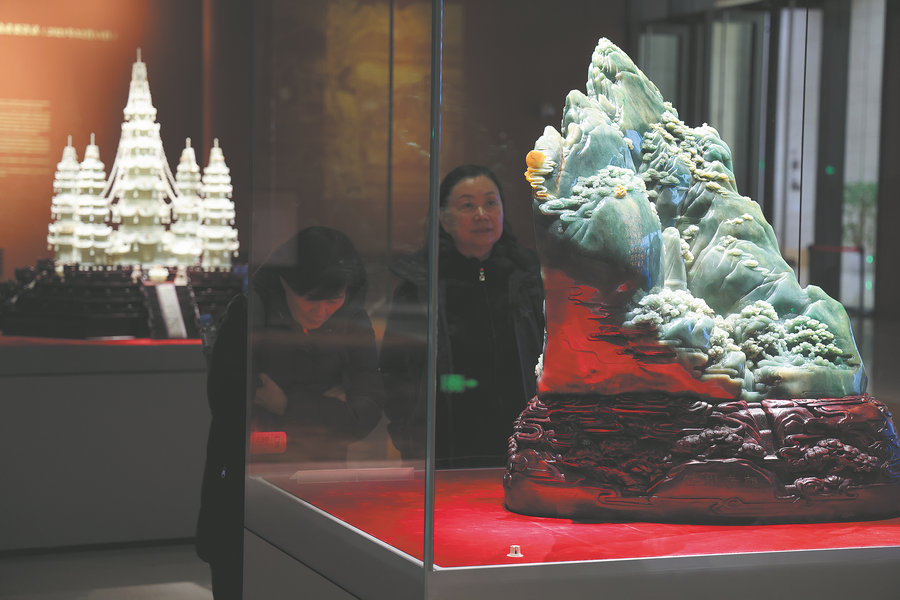
This miniature Taishan Mountain is among the four jadeite ornaments housed at the museum that are dubbed "national treasures". Produced in the 1980s, they took more than 40 Beijing-based jade artisans eight years to complete, according to museum guide Yang Yuwei.
From these pieces, the delicacy, complexity and diversity of jade caving — a time-honored craftsmanship — are fully revealed.
Chinese people have a long-lasting attachment to jade, which probably accounts for their continuous drive to improve the craftsmanship of jade carving.
From the around 9,000-year-old Xiaonanshan site of Northeast China's Heilongjiang province, archaeologists have excavated more than 200 pieces of jade ware, the earliest known in China.
Exquisite jade ornaments and vessels of various sizes, shapes and textures have also been found in subsequent relic sites across the country or passed down through history, exhibiting aesthetics and ritual significance and symbolizing wealth and social status.
Above all, jade has always been associated with human virtue — gentleness, inclusiveness, integrity, resilience and purity, to name a few — and the efforts taken to maximize the charm of the stone are frequently compared to the polishing of people's fine character.
A household rhyme goes, "Jade, if not refined, will not become a useful ware. A person, if not learn, will not understand the principles of life."
The main procedures of jade carving, handed down throughout thousands of years, include qie (cutting), cuo (grinding), zhuo (carving) and mo (polishing).
These four Chinese characters form a commonly used phrase meaning exchanging ideas while mutually learning, and pondering on a specific problem over and over again — an apt metaphor of the long journey to become a jade-carving master.





