Positive forecast for 2025 in auto sector
New energy vehicles may enjoy 30 percent growth rate, industry body predicts









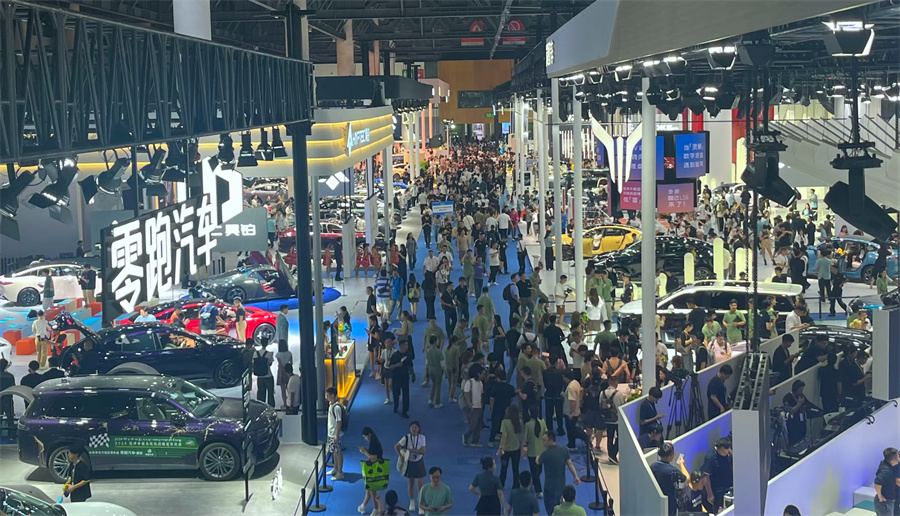
China's automotive industry is set to maintain its leadership in global markets in 2025, with a major industry think tank forecasting total vehicle sales to reach approximately 32 million units in 2025, representing a 3 percent year-on-year increase.
Zhang Yongwei, vice-president and secretary-general of the China EV100, gave the estimate last week.
He expects new energy vehicle sales in the year to hit 16.5 million units, achieving a growth rate of roughly 30 percent from 2024. He went on to explain that the domestic NEV market will comprise 15 million units, supplemented by exports exceeding 1 million units.
Zhang emphasized the automotive industry's evolution, moving from a period of rapid growth between 2021 and 2024 to a phase of stabilization and high-quality development.
"When the NEV penetration rate approaches around 50 percent, as it does now, the market naturally shifts from rapid growth to a more stable trajectory. This marks the industry's entry into a mature phase," Zhang explained.
In 2025, NEVs are expected to account for more than 55 percent of total vehicle sales in the Chinese market, reaching a new milestone of high-quality development.
Compared with pure electric vehicles, plug-in hybrids and extended-range vehicles are expected to gain prominence, constituting nearly 50 percent of the NEV market in 2025.
The trend is also confirmed by carmakers. Many of those who were dedicated to EVs are rolling out such vehicles, including Avatr, Aito, Zeekr and Xpeng.
Volkswagen is planning plug-in hybrids and extended-range vehicles as well, expecting them to boost its market share in China, its largest market in the world.
Zhang highlighted this as a reflection of the industry's increasing technological diversity.
"These hybrid technologies represent a fusion of advanced electric and fuel-based systems, providing viable solutions for varied market demands," he noted.
Going hand in hand with electrification is smart technology integration, which is accelerating across the automotive landscape.
Advanced driver-assistance systems are increasingly prevalent. Zhang projected that in 2025, 65 percent of passenger vehicles will feature Level 2 or higher autonomous driving capabilities.
Also these functions, which were reserved for premium vehicles, are now available in less expensive models.
"The integration of intelligent technologies will move beyond luxury vehicles to become accessible in mainstream models priced between 100,000 ($13,700) and 200,000 yuan," Zhang said.
Zhang also addressed the go-global issue of China's automotive industry, advocating for deeper integration in overseas markets.
Statistics show that exports of China-made vehicles, including those from global brands such as Tesla and Hyundai, totaled around 5.84 million units from January to November 2024, up 23 percent year-on-year.
As the volume of exports grow, Zhang said it is necessary for carmakers to consider the long-term overseas development strategy.
"We need to transition from a trade-driven approach to an investment-driven one. This involves establishing local partnerships and adapting to unique regulatory environments," he explained.
Zhang cited the Leapmotor and Stellantis partnership as an example, which allows the Chinese startup to leverage Stellantis' network to market its vehicles while enabling the two to partner up in terms of NEV technology.
He noted that while international brands face significant challenges in adapting to China's rapidly evolving domestic landscape, they retain strong positions in global markets.
Looking ahead, Zhang added that if they can regain the glory in China, it all depends on smart technology, ranging from smart cabins to autonomous driving.
"The key differentiator in the next phase will be smart technology, where local brands currently hold an advantage," he said.
On the subject of AI integration, Zhang identified 2025 as a pivotal year for applying AI across the automotive life cycle.
"AI will reshape the industry, from research and production to sales and after-sales services, creating immense opportunities for innovation," he said.
Besides, the commercial vehicle sector is poised for significant growth, with NEV sales projected to exceed 900,000 units in 2025 — a staggering 80 percent year-on-year increase.
Heavy-duty trucks are expected to lead the charge, with the NEV penetration rate surpassing 20 percent.
"The total cost of ownership for NEV commercial vehicles is becoming increasingly advantageous compared to traditional models, further driving adoption," Zhang said.
As the automotive industry enters 2025, Zhang emphasized the need for a balanced approach to innovation and market consolidation.
With steady growth and strategic international expansion, China is well-positioned to sustain its leadership in the global automotive sector.
"The journey ahead will demand high-quality development and collaboration," Zhang said.