Rise of a new manufacturing powerhouse
GBA sets sights on becoming hub for next-generation industrial revolution









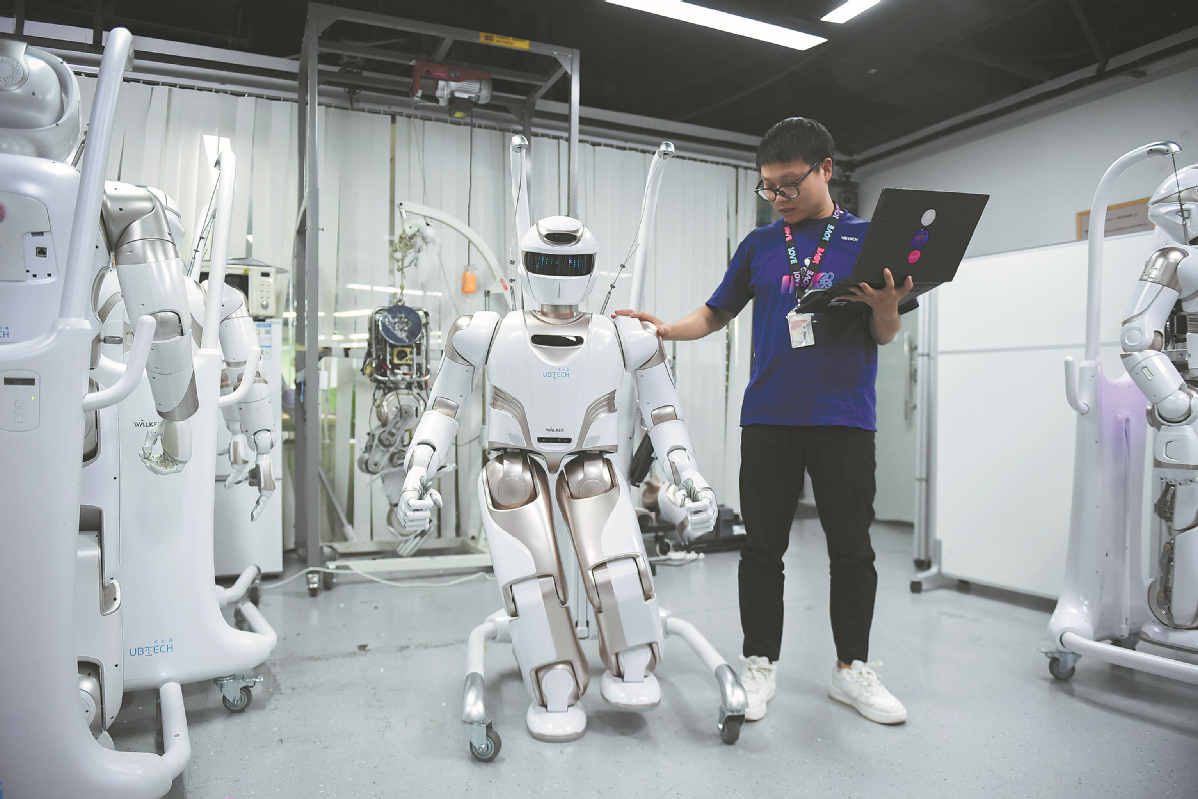
"Made in China" once evoked images of low-cost, labor-intensive commodities. Many years later, the tag stands for advanced innovations such as electric vehicles and drones.
A major participant in this evolution is the Guangdong-Hong Kong-Macao Greater Bay Area, a region in South China made up of 11 cities and 87 million residents. The GBA has not only mirrored the nation's transformation from a world factory to a smart manufacturing hub, but has also incubated 70 unicorn companies — startups valued at over $1 billion each.
So influential has the rise of this particular region of South China been, that it has developed its own epithet — products made here are not just "Made in China" they're "Made in the GBA".
In Guangzhou's newly developed Nansha district, Kenny Oktavius, the young CEO of the tech startup PointFit Technology, showcases his company's latest innovation — a super-thin chip designed for use in sports.
"We can stick it to the skin without any adhesive. So, this will definitely be much (more) convenient, especially for athletes who don't like bulky wearables," he said.
The tracker, which monitors muscle health through sweat analysis, is designed and produced within the GBA.
An Indonesian from Jakarta, Oktavius came to the Hong Kong University of Science and Technology in 2015 for his bachelor's degree in chemical and biological engineering, later proceeding to postgraduate studies.
Mentored by professor Gao Ping, a chemical engineering specialist, Oktavius launched PointFit Technology in 2020 with two research partners, based on an idea of a sweat-sensing wearable device he had developed during his senior-year research.
The product quickly gained the industry's attention, winning several health tech awards and securing a spot on Forbes Asia's 100 To Watch list in 2022 — a roster for small companies recognized for their trailblazing solutions to global challenges.
The GBA's manufacturing expertise has been instrumental in the rise of the young team.
Initially, Oktavius sought out a Taipei manufacturer for production. While functional, the prototype's quality was subpar. Later, a better-equipped manufacturer in Shenzhen, offering a shorter production cycle and superior quality, proved to be the solution.
"Recently, we just produced 300 of these (chips) in one day," Oktavius said, clearly impressed.
Jack Chen, chief operating officer and co-founder of PointFit Technology, added that GBA factories are uniquely open to innovation.
"They are willing to accept new ideas and modify their machines if the existing ones cannot realize our demands," he said.
Professor Gao expressed full confidence in the practical application of the ultra-high-molecular nanomembrane developed by her students, a material previously confined to laboratory research.
"In the GBA, we can look up at the sky, and work down-to-earth," she said, referring to the region's robust industrial supply chains that facilitate the industrialization of "dream big" research projects.
Ambitious scientists like Oktavius and Chen, thriving in Hong Kong's academically rich environment — home to five of the world's top 100 universities — are becoming a more significant driving force behind the region's innovative prowess. Supported by regional government funds, they are following in the footsteps of DJI and SenseTime — which both originated on Hong Kong campuses — in aiming for global enterprise leadership.
Furthering their ambitions, Oktavius' team has established a subsidiary in the Hong Kong & Macao (International) Youth Entrepreneurship Hub in Guangzhou's Nansha district, to better streamline their supply chain integration.
This hub is a cradle for about 74 startups across diverse sectors such as internet technology, healthcare, advanced materials, green energy and education.
Oktavius points out the region's potential as a global smart manufacturing powerhouse. "That's essentially the edge that the GBA startup community has."