



High-tech inspections bolster high-speed rail safety amid Spring Festival rush









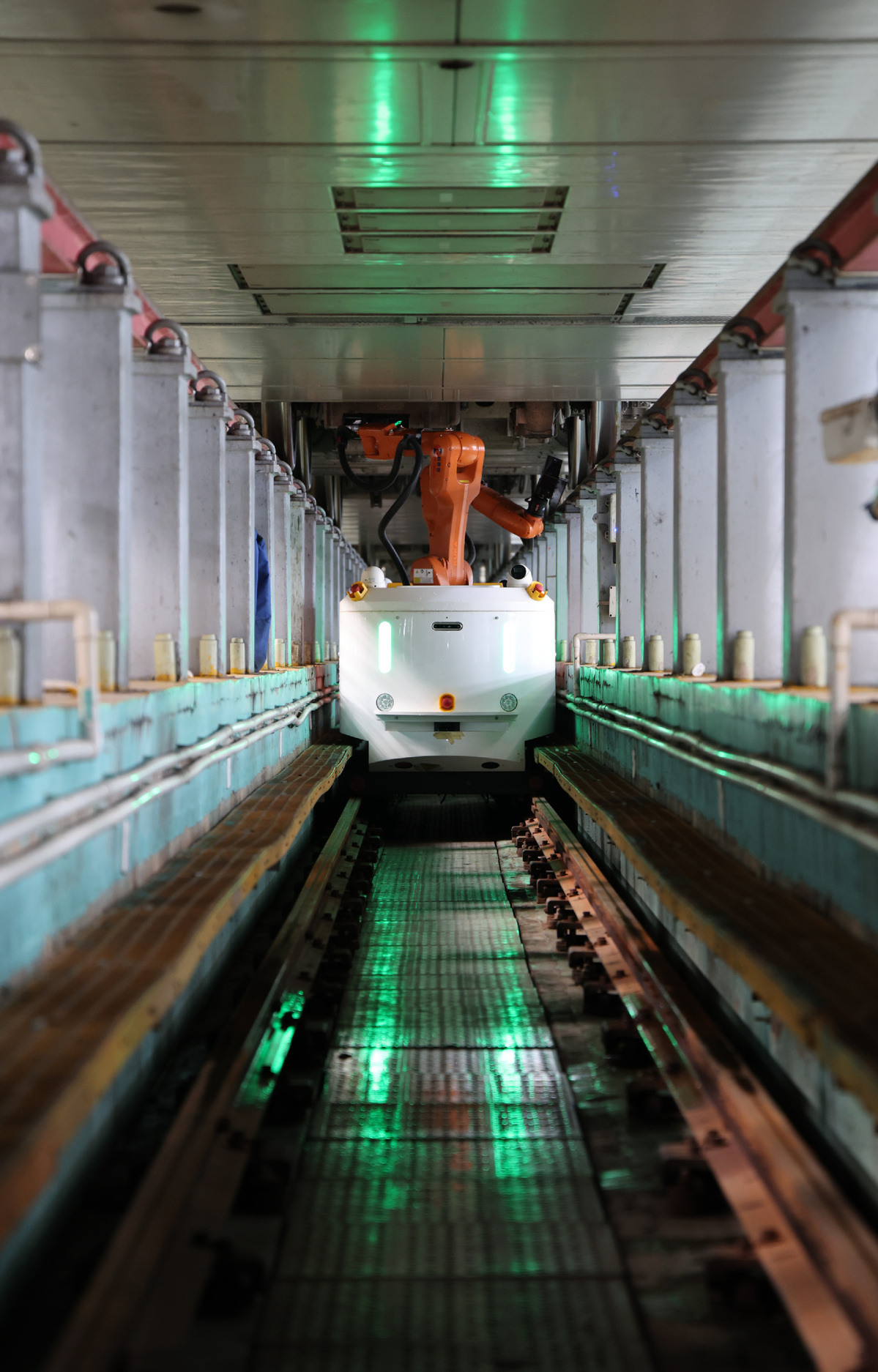
NANJING -- At midnight, after a busy day, a high-speed train rolls into Nanjing South Railway Station, a key hub in East China's Jiangsu province. Here, a team of technicians and intelligent robots stand ready to perform inspection tasks.
Using laser radar navigation and positioning technology, the robots move smoothly along tracks. Equipped with two articulated arms featuring imaging devices, they adjust height and angle, meticulously scanning the train's underside and components, while transmitting real-time artificial intelligence (AI) analysis for further review.
During this year's 40-day Spring Festival travel rush, which began on Jan 14, China's railway network is expected to transport 510 million passengers, with around 14,000 trains operating daily. To ensure operational safety during this high-traffic period, trains must undergo rigorous inspections every three days of service.
Inspecting these sophisticated trains is no small task. A standard eight-carriage high-speed railway requires a comprehensive check of more than 10,000 components, from bolt tightness to oil leakage and component wear.
"The manual inspection of a standard train requires at least two inspectors working for two and a half hours. With the use of robots, the process is reduced to just one hour, and staff only need 10 minutes for a final review -- tripling efficiency compared to manual inspections, while also improving our working conditions," said Qi Zhengang, an inspector at the railway station.
Currently, intelligent inspection robots are deployed not only in Jiangsu but also in railway stations across cities like Jinan, Beijing and Shanghai.
Across the country, a variety of high-tech solutions are being implemented to ensure the safety of the high-speed rail network during the travel surge.
Electricity is the primary power source for high-speed trains. To meet soaring energy demand, the Haogang substation in South China's Guangdong province has adopted drones equipped with infrared, ultraviolet and sonic imagers to patrol the Shenzhen section of the Guangzhou-Shenzhen-Hong Kong high-speed railway.
With the technology, invisible currents can be converted into visual patterns, cutting the maintenance time from 30 minutes to 15 minutes, said Tan Chuanbin, an employee at the substation.
Featuring a wide field of view and AI-driven analysis, drones are also used to monitor and assess precarious rock formations and geological hazards along railway tracks in mountainous regions such as southwest China's Guizhou and Sichuan.
China's high-speed rail network has seen extraordinary growth. In 2010, the country had 8,358 kilometers of operational high-speed rail. The number had skyrocketed to 48,000 kilometers by the end of 2024.
"China's high-speed rail advancements are built on continuous technological innovation," said Duan Wei, deputy chief of the high-speed rail infrastructure department of the Huai'an section of Jiangsu.
"Looking ahead, we expect AI and the Internet of Things to be further integrated, enhancing real-time monitoring and predictive warnings to better ensure passenger safety," he said.


- Former head of national TCM administration indicted for bribery
- Wuhan University researchers return from five-month Antarctic expedition
- New city established in Xinjiang
- China launches high-precision greenhouse gas detection satellite
- Shenzhou XXI astronauts complete third spacewalk
- It's the posters who should pay when spreading malicious rumors online





