China's desertification control efforts embrace high-tech solutions










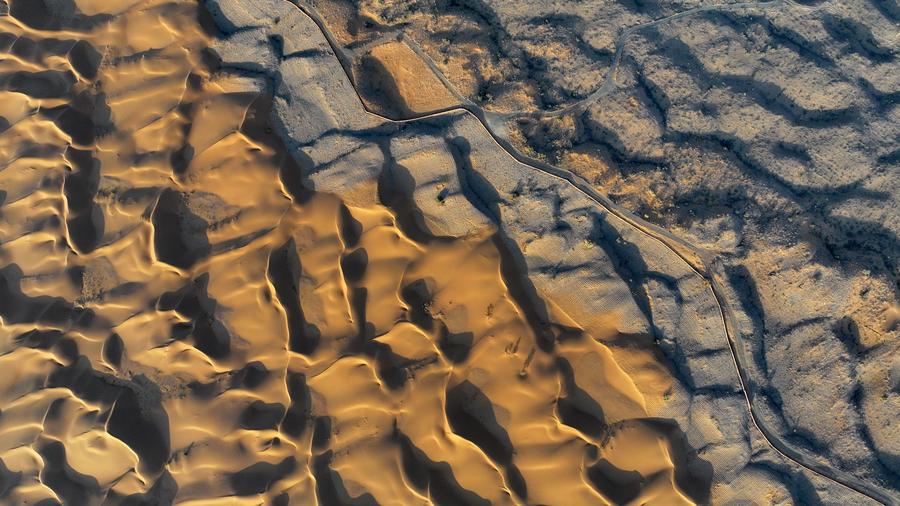
YINCHUAN -- From employing biotechnological techniques to deploying a range of AI-powered automated machines, China has actively embraced innovations to replace strenuous manual labor in its efforts to build ecological barriers against desertification.
Tuesday marked World Day to Combat Desertification and Drought. Often described as the "cancer of the earth," desertification is a global challenge affecting more than 100 countries and regions. China, one of the countries most severely impacted, has made significant strides in halting desert expansion through its decades-long afforestation campaign.
Winding through towering sand dunes along the edge of the Tengger Desert, China's fourth-largest, the Lanzhou-Baotou Railway, built in 1958, has not only remained well-maintained and free from encroaching sand over the decades but has also helped transform the barren landscape. Its shelter belts have fostered the growth of biocrust, bringing new life to the once-desolate land.
The green belt protecting this vital transport artery stands as a near-miracle in the arid landscape. Over the past 60 years, massive human efforts have been mobilized in Zhongwei city, in Northwest China's Ningxia Hui autonomous region, to create "straw checkerboard," a dune stabilization technique where straw is laid out in a checkerboard pattern on the desert surface. These grids have provided a foundation for vegetation to take root and gradually transform the sand into green.
Nicknamed the "Chinese Rubik's Cube," the technique is now widely adopted both across China and internationally to increase soil surface roughness, effectively reducing wind erosion in sandy areas.
Within the checkerboards, the sand surface gradually forms a soil crust that helps prevent wind-driven movement. To speed up this process, Chinese researchers have developed lab-cultured cyanobacteria that accelerate the formation of biological soil crusts.
"Under natural conditions, the formation of biological soil crusts takes 10 to 20 years. With the application of cyanobacteria, that process can be shortened to just one year," said Zhao Yang, a researcher at the Northwest Institute of Eco-Environment and Resources under the Chinese Academy of Sciences.
Zhao added that the technology has already been applied across more than 267 hectares in Ningxia, with plans to further expand its coverage in the coming years.
By spraying cyanobacterial liquid onto the sand surface and combining it with the straw checkerboard technique, stable artificial biological soil crusts can form within 10 to 16 months. In treated areas, wind erosion has been reduced by over 95 percent, the survival rate of sand-fixing shrubs has increased by 10 to 15 percent, and the need for seedling replacement has dropped by nearly 40 percent, significantly cutting the overall cost of sand control, Zhao explained.