


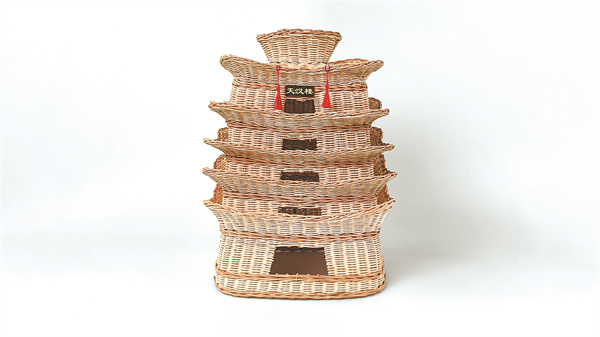
Intricate process
Since the age of 7, he was mesmerized by his father's calloused hands, from which soft rattan vines seemed to come alive, morphing into chairs, baskets, sun hats, and occasionally even a little grasshopper, playfully woven just for him.
He began to realize the value of those unremarkable green rattan growing just outside their home, as his father brought home an envious income through selling rattan-woven chairs.
At the age of 15, he formally made inroads into the craft under the guidance of his father.
"My father constantly reminded me of the outstanding craftsmanship of my grandfather," he recalls.
The whole process is intricate, involving over 20 steps, including material preparation, frame construction, rattan weaving, polishing and finishing.
After 2-year-old bamboo and rattan are harvested and air-dried in shaded, ventilated areas, they are steamed for hours to kill insect eggs and soften the fibers. Afterward, the materials are peeled, rinsed, sun-dried, and trimmed into usable strips.
Next comes the frame-making stage, where high-quality wood and bamboo are bent into geometric forms using fire-and-water techniques, then fixed with bamboo nails and bound with rope.
The core step is for artisans to weave rattan strands around the frame in a fill-in pattern.
After securing the warp threads, the weft is woven in, incorporating various colored patterns and finishing with edge-wrapping techniques. Finally, skilled finishers trim excess fibers, apply filler, sand the surface, and add a protective coating to complete the piece.
Though the rattan vines were soft to the touch, they rubbed Chen's fingers raw. Through rigorous training, it took Chen several years to complete his apprenticeship in 1990, when he began hawking his handmade goods through the streets.
"Seeing my own works turn into real income was really joyful," he says.
However, in the late 1990s, with the rapid rise of the modern furniture industry, traditional rattan-weaving businesses across Hanzhong began to shut down one after another.
It was his father's final wish for him to keep the ancestral craft going that enabled him to stay on track.
His persistence eventually won him increasing support from the government. In 2007, Chen established a formal cooperative and later a rattan-weaving company.





