


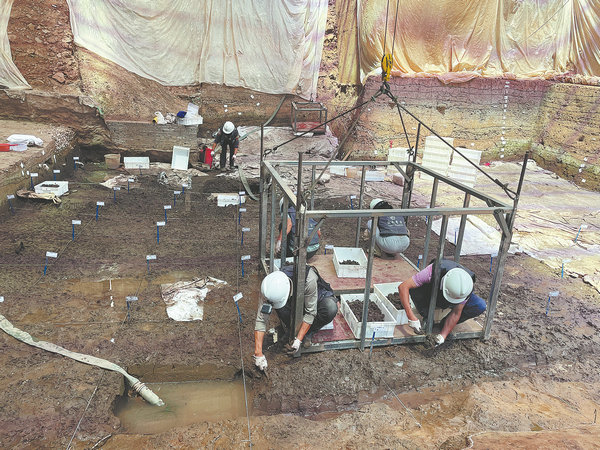
The Hebosuo site is about 1 kilometer away from the Shizhaishan site, where ancient tombs of the King of Dian are located. In fact, after the ancient tombs of the King of Dian were discovered, Jiang and many other archaeologists spent decades searching for the residential and living areas of this remote small kingdom. However, they never connected the location of Yizhou Commandery mentioned in historical records with the capital of the Dian Kingdom. It wasn't until the unearthing of a large number of official seal impressions in 2018 that they realized the ancient capital of the Dian Kingdom was actually the later Yizhou Commandery.
The discovery of tens of thousands of inscribed wooden slips provides concrete evidence that this location was indeed the site of the ancient Yizhou Commandery. Previously, the existence of the commandery was known only from historical records. After 2021, a significant number of Han Dynasty city walls, moats, roads, and the foundations of large buildings have also been uncovered at the site, along with inscribed tiles and official seals related to the Yizhou Commandery.
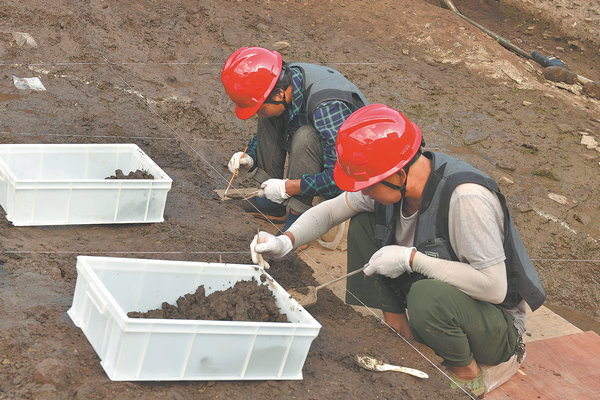
The vast number of inscribed wooden slips and the task of organizing the inscriptions on them require considerable time and effort. Su Dongxiao has dedicated herself to sorting and studying these slips at the Hebosuo site for several years.
She explains that the inscriptions provide detailed records of the names of the 24 counties of Yizhou, along with a wealth of information reflecting various aspects of society at the time. This ranges from government administration, such as the taxation and judicial systems, to everyday matters like parcel delivery and household registration.
Among these wooden slips, there are more than a dozen featuring pictorial representations, a very rare type. Some of these depict local animals, such as horses used for transportation.
Su explains that this is likely because, after the Han dynasty central government took control of the area, there was extensive interaction with local society. The illustrations of horses on the slips might have been intended to showcase the unique characteristics of the local horse breeds.
Another pictorial wooden slip features a simple human figure. The facial area of the figure, including the forehead, eye sockets, and nose, was distinctly painted with red cinnabar. However, the specific interpretation of this image requires further research.
"These wooden slips are very detailed and reflect everyday life, vividly outlining various aspects of society and life in this county at the time. They are invaluable resources for studying a local regime during the Han Dynasty," says Su.





