


Fantasy tale finds new fans?
Popular xianxia drama rooted in tradition and ancient literature makes a splash overseas, Xu Fan reports.









"Most of the previous xianxia dramas use wild imaginations, but they don't really think through how mythological characters should move or act in a believable way. We spent a lot of time brainstorming, hoping to make it easy for the audience to tell celestial beings apart from humans," explains Guo.
Filming took place between April and August last year at Hengdian World Studios in Zhejiang province, one of China's largest film and TV production bases. Feud's cast and crew members shot some of the most challenging scenes in the scorching summer heat.
In one such scene, actor Zeng, who plays the supreme god Bai, was suspended on a complex rigging system, hung on wires and maneuvered by a crane, to simulate a fall from midair. Below him, a pond had been prepared in advance with 10 explosive devices to create a dramatic visual of the character's magical power.
"It was nearly 44 C that day, but both he and actress Bai patiently enacted the scene multiple times to get it right," recalls Guo.
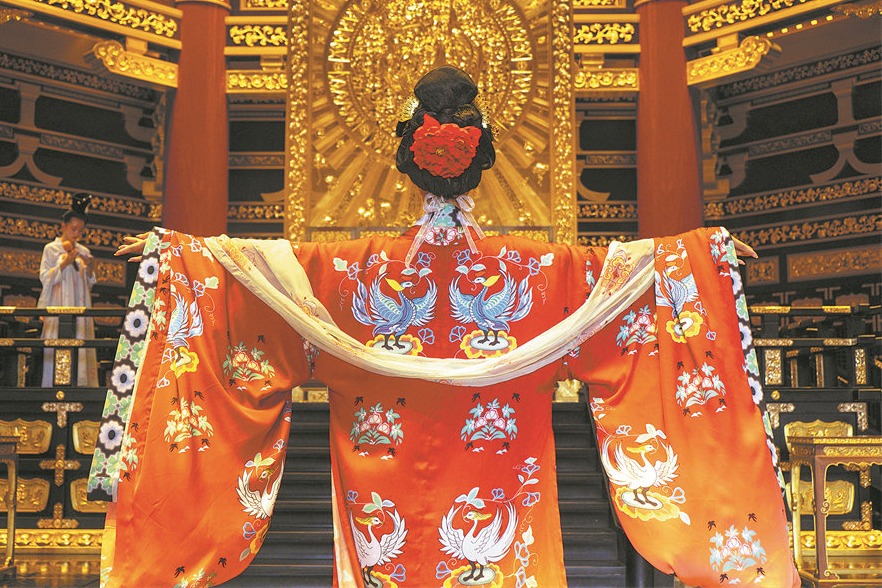
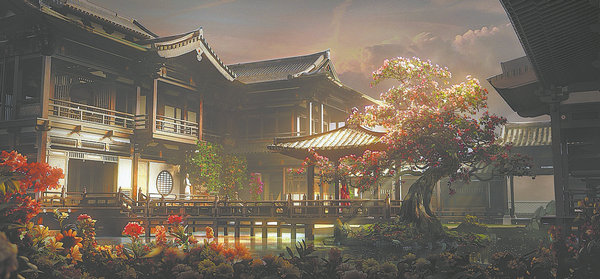
Traditional Chinese architecture plays a pivotal role in shaping the visual aesthetics of the drama. According to art director Luan Hexin, the two iconic palaces serving as the residences of the protagonists have drawn inspiration from the distinctive architectural styles of Lingnan, a culturally rich region encompassing Guangdong and Hainan provinces, the Guangxi Zhuang autonomous region, and parts of Yunnan and Fujian provinces.
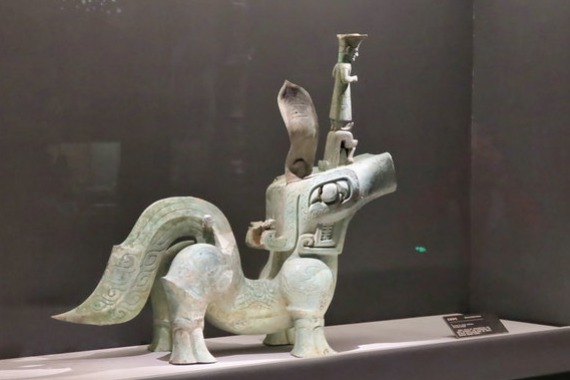
He also explains that the architectural elements of the heavenly palace, including its beams, pillars and windows, have drawn inspiration from artifacts of the Shang Dynasty (c. 16th-11th century BC) and the Tang Dynasty (618-907).Depicted as floating above swirling clouds and rosy mists, the palace features 200 jade-like buildings, 1,500 vivid lifelike statues, and more than 10,000 towering beams.