


Exhibition zooms in on Yangtze's tide of history










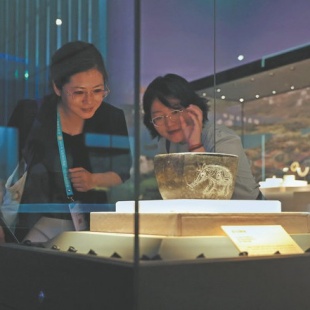
In particular, a stunning black pottery vessel from the Zhejiang Provincial Museum, painted on both sides with wild boars, suggests early animal domestication and artistic representation, Wang points out.
"The object itself also demonstrates advanced pottery carbonization techniques from over 7,000 years ago," he adds.
The last bit of the section features a display of silkworm cocoons and woven fabrics from sites like Qianshanyang of Zhejiang province dating back more than 4,000 years, which illustrated another major contribution of the Yangtze civilization to silk weaving. "These advances were linked to broader themes of innovation and adaptation in prehistoric society," he says.
Arrays of imposing bronze items of various shapes and sizes take center stage at the Brilliant Convergence chapter that showcases how the Yangtze River contributed to the development of crafts, governance and philosophy.
Archaeological excavations from Panlongcheng (in modern-day Wuhan, Hubei province) dating back to the early Shang Dynasty (c.16th-11th century BC) reveal the earliest adoption of Central Plains bronze technology, says Fang Fang, co-curator behind the chapter.
"Here, ritual wine vessels like the jue and jia sets show remarkable similarity to the prototypes of Erlitou culture (dating to between 3,750 to 3,520 years ago in today's Henan province), particularly in their arrangement and casting techniques," Fang says. "However, subtle local adaptations already appear in details like tapered legs and miniature beast masks, signaling the beginnings of a distinctive southern bronze tradition."
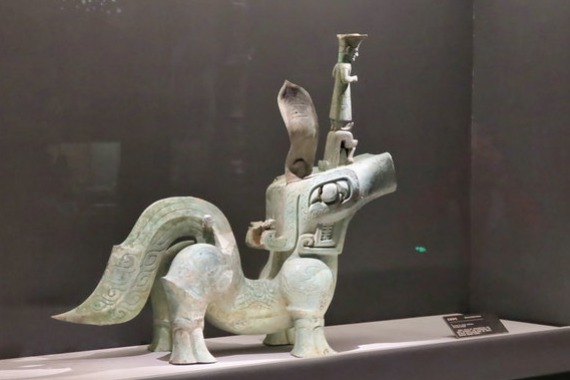
Bronzeware exhibits from the Sanxingdui culture (estimated to be 3,000 to 3,600 years old) in Sichuan province reveal extraordinary mythological hybrid creatures that blended human and animal features. Further east, large lei wine containers found in Hunan from the Shang Dynasty adorned with aquatic motifs reflected the region's wetland ecology, while the eastern Jiangxi province-based Wucheng culture from the Shang period developed its own avian-inspired designs, exemplified by the bird-eared ding tripod.
"These regional variations demonstrate how bronze technology served as a medium for expressing local environmental and spiritual relationships while maintaining connections to Central Plains ritual systems," Fang explains.