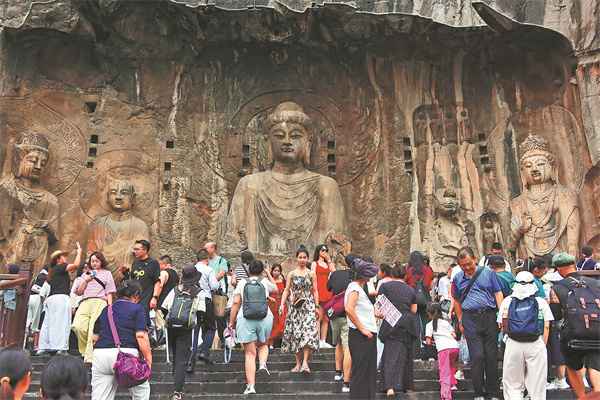
The number of identified cave temples in China continues to increase. In the ongoing fourth national census of cultural relics in China, which began at the end of 2023, experts have discovered a number of new cave temples, which refer to grottoes and sculptures carved into cliffs or mountains, and the remains of temple sites and cliffside statues, in places like Shaanxi, Sichuan, and Gansu provinces, the Xizang autonomous region, and Chongqing.
In Chongqing, 108 cave temples and cliff statues have been found to date from the Tang (618-907) to the Qing (1644-1911) dynasties.
"The newly discovered cave temples further clarify the total number of cave temple resources. Their preservation nationwide provides an important reference for their scientific protection and management," says Niu Yingbin, a researcher at the Chongqing Cultural Heritage and Archaeology Institute.
The data were released at the 2025 International Forum on Cave Temple Conservation held in Luoyang, Henan province, from Tuesday to Thursday, organized by the National Cultural Heritage Administration.
Under the theme "the protection, inheritance and value dissemination of cave temples", the event brought experts from more than 10 countries and international organizations, including the United States, Japan, and Cambodia, to discuss the research, protection and management of cave temples.
Fan Jinshi, honorary director of Dunhuang Academy, says in a video clip that cave temples originated in ancient India and were introduced to China with the eastward spread of Buddhism.
A special survey, carried out in 2021 on cave temples nationwide, showed that China had 5,986 cave temples and cliff statues at that time, forming the largest-scale cave temple group worldwide.
Among the cave temples, China boasts the UNESCO World Heritage sites of the Mogao Caves in Dunhuang, Gansu province; the Dazu Rock Carvings in Chongqing; the Longmen Grottoes in Luoyang; and the Yungang Grottoes in Datong, Shanxi province.
"China's cave temples not only showcase the solemnity, brilliance and timeless charm of the country's outstanding traditional culture and art, but also record the fusion of Indian Gandhara art with traditional Chinese carving and painting techniques," says Fan.
Chinese experts have studied methods to better protect cave temples for over eight decades, from on-site guardian protection to rescue and reinforcement protection, and scientific protection.
"Currently, the protection of China's cave temples is experiencing a leap from 'rescue protection' to 'preventive protection' mindset," says Fan.
Su Bomin, director of Dunhuang Academy, says that in recent years, the academy has carried out a series of projects to protect murals and painted sculptures, and reinforce the cave temple structures.
They have improved and refined everything from materials to key processing technologies based on previous work, making them more suitable for contemporary cave temple protection.
"We are protecting the cultural heritage that belongs to humanity. Therefore, the technologies we develop and the practical theories we propose must be shared in such an international event so that we can work with our foreign counterparts to better protect our own cultural heritage" says Su.
Nawaz-ud-Din Siddiqui, director of the Swat Museum in Pakistan, says China's experience is significant for protecting the cave temples in his country.
"Climate change has brought new challenges for our heritage conservation work in recent years," he says. "For example, we are facing a flood these days, a rare phenomenon that is becoming increasingly frequent, which may influence the cultural relics in my country. Chinese experts have done extensive research on how to prevent the influence of water on the heritages; and their experience can be inspiring for us."