



Lunar basin formation period altered









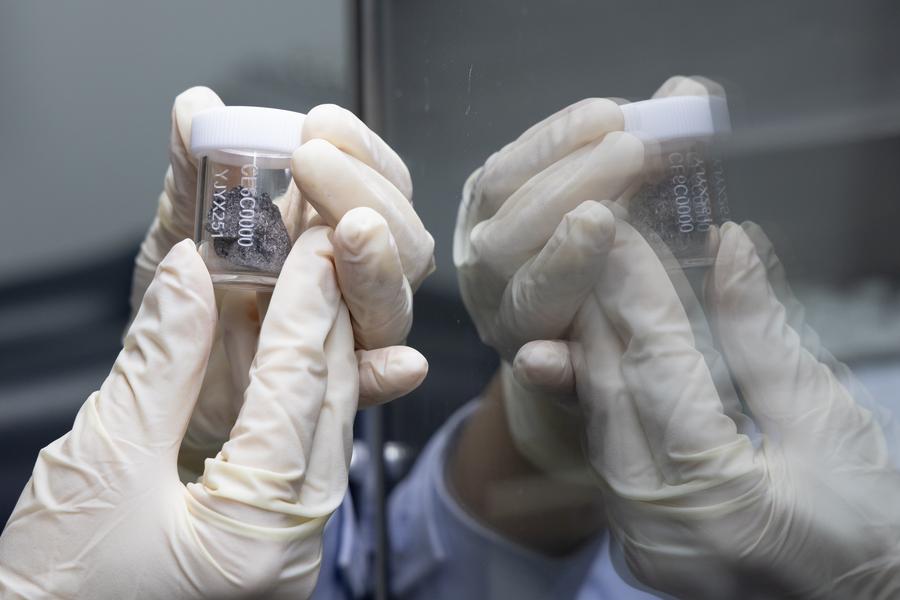
A study of lunar samples retrieved by the Chang'e 6 mission has dated the formation of the Apollo basin to 4.16 billion years ago, meaning the onset of the late heavy bombardment occurred at least 100 million years earlier than thought. The finding offers new insights into the early dynamic evolution of the moon and the solar system.
The late heavy bombardment refers to a period of lunar basin-forming epoch due to intense bombardments from small celestial bodies.
The Apollo basin, where the Chang'e 6 mission sampled lunar soils, has a diameter of about 540 kilometers. As the largest crater within the moon's largest and oldest impact basin — the South Pole-Aitken basin — its formation might well indicate the onset of the late heavy bombardment.
Through the analysis of samples from the far side of the moon, the study reveals that the late heavy bombardment initiated at least 4.16 billion years ago, which is 100 million years earlier than the previously suspected cataclysm between 3.8 to 4 billion years ago. This finding suggests that the lunar early impact flux is consistent with a gradual decline rather than an abrupt surge.
According to the study published in the journal Nature Astronomy on Wednesday, the research team, led by Xu Yigang, an academician from the Guangzhou Institute of Geochemistry of the Chinese Academy of Sciences, examined three impact-melt fragments with sizes ranging from 150 to 300 micrometers. These fragments are a special type of lunar rock that formed through the cooling and crystallization of impact melts generated during impacts and are regarded as the most ideal "geological clock" for the impact records of the moon.
Integrating remote sensing, geological, geochemical and petrological data, the study confirms that the Apollo basin formed around 4.16 billion years ago.


- World's highest bridge boosts Guizhou tourism beyond expectations
- Iraqi journalist: China brings peace to the world
- China's emerging pillar industries to surpass 10t yuan in 2030: official
- Xi visits political advisers, joins discussion at annual session
- Hebei eyes stronger regional integration
- Volunteer crawls through mud to rescue trapped gull in Qingdao





