



Test launch marks push in reusable space vehicles









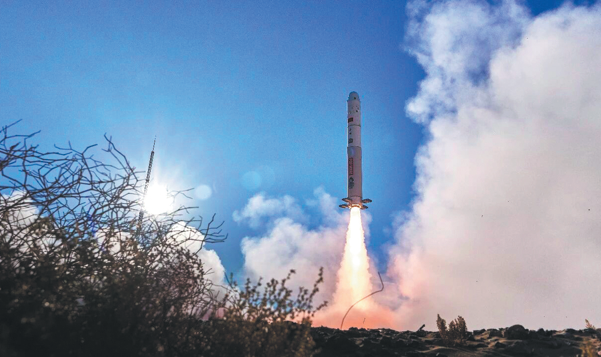
A Chinese spacecraft designed for suborbital spaceflight and future space tourism completed a successful test mission on Monday, marking a step forward in China's push to develop reusable commercial space vehicles.
The spacecraft, designated PH-1, carried out its maiden suborbital flight in Northwest China, according to its developer, CAS Space, a Beijing-based commercial aerospace company. The test was conducted at the Jiuquan Satellite Launch Center, located on the edge of the Gobi Desert in the Inner Mongolia autonomous region.
The vehicle lifted off at about 4 pm and reached an altitude of roughly 120 kilometers, passing the Karman line — commonly regarded as the boundary between Earth's atmosphere and outer space — before descending back to Earth. After re-entering the atmosphere, its recoverable payload cabin deployed a parachute at around 10 km and landed smoothly at a designated site, the company said.
CAS Space said the test validated key technologies, including re-entry deceleration, parachute recovery and precision landing control. Engineers also assessed the performance of critical components during the flight.
The unpowered payload cabin separated from the booster at an altitude of about 70 km and continued upward through inertia before beginning its descent. The company said the mission demonstrated the spacecraft's ability to provide a stable microgravity environment for more than 300 seconds.
The payload included an experimental laser-based 3D printer designed to operate in microgravity, as well as rose seeds that had previously flown in space aboard another spacecraft.
Shi Xiaoning, the spacecraft's chief designer and project manager, said the PH-1 is primarily intended to support low-cost suborbital scientific experiments. He said it can provide minute-level, high-quality microgravity conditions that are difficult to achieve using ground-based facilities such as drop towers or parabolic aircraft flights.
Shi said potential applications include space-based plant breeding, biomedical research and materials testing. He added that once the technology matures, similar spacecraft could also be used for suborbital space tourism, offering passengers brief experiences of weightlessness.
According to CAS Space, the PH-1 design emphasizes low launch costs, flexibility and reusability. The company said future versions of the recoverable payload cabin are expected to be upgraded to orbital-grade spacecraft capable of staying in orbit for up to one year and being reused about 10 times, including for in-orbit manufacturing.
China's commercial space sector has expanded rapidly in recent years, with both State-owned contractors and private companies developing reusable rockets and spacecraft. Several have already conducted test flights as China seeks to lower launch costs and expand its presence in space.


- 2026 Spring Festival rush: 258M railway trips
- China renews blue alert for cold wave, strong winds
- Second volume of book on Xi's visits to people's homes published
- Respect Moment | Guardians of Peace
- Chinese tourists soak in festive vibes of Spring Festival
- China sees record daily passenger flow in Spring Festival travel rush








