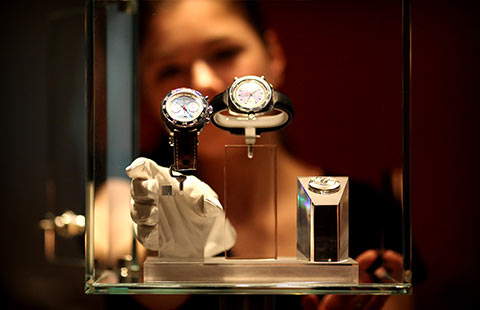
If you are bored sitting in front of your desk, staring at the computer, what you probably need is a new lamp — an intelligent lamp that projects onto your desk turning it into a large touch screen.
With such a lamp, you will be able to finish your work, surf the Internet, play games, or even play the piano by banging the "keys" on your desk — or on the wall if you wish — just connect the smart lamp to your phone or computer.
This is not the latest Apple gadget, but technology developed by the Shenzhen Institutes of Advanced Technology, one of the youngest research institutes under the Chinese Academy of Sciences.
"I used to have this stereotyped image that scientists at the Chinese Academy of Sciences were like those pedants who sit in front of their microscope, writing papers that people never understand, and brushing off interesting technologies," said Li Qing, a science reporter from Beijing, after seeing the lamp at a science and technology exhibition in Shenzhen.
 "I never expected they would develop such an interesting piece of technology."
The Shenzhen institute, together with some six other institutes, was established in the several years from 2006 to compliment the traditional role of the CAS. The new institutes focus on supporting the business sector with technologies.
The institutes are scattered throughout Ningbo, Guangzhou, Shenzhen, Xiamen, Suzhou, Qingdao and Yantai, and focus their resources on applied technologies, for example, breeding white shrimp in coastal regions of South China.
Having enjoyed some early success in the business world, the CAS authorized the establishment of three new institutes last week.
The three institutes, the Shanghai Advanced Research Institute, Tianjin Institute of Industrial Biotechnology, and Suzhou Institute of Biomedical Engineering and Technology, are set to meet the technical demands of local companies.
"The companies know exactly what kind of science and technology they need, and how to generate economic value from technology," said Shi Erwei, vice-president of the CAS.
"As China changes its development mode, it is essential to give companies more convenient access to high-quality sci-tech resources," Shi said.
Established in November 1949, the CAS is the highest-level scientific institution in China. It now has 60,000 employees working in 12 branch offices, more than 100 institutes, more than 100 national key laboratories and national engineering research centers, and about 1,000 field stations nationwide.
But the institutes, in most cases, place too much emphasis on fundamental research and lack the capacity for technology integration and product development.
"The institutes find no buyers for their innovations because their technology cannot be directly applied to production, while companies cannot find the technologies they urgently need," Shi said.
"The value chain linking the research and the production is so fragile."


Copyright 1995 - . All rights reserved. The content (including but not limited to text, photo, multimedia information, etc) published in this site belongs to China Daily Information Co (CDIC). Without written authorization from CDIC, such content shall not be republished or used in any form. Note: Browsers with 1024*768 or higher resolution are suggested for this site.
License for publishing multimedia online 0108263 Registration Number: 130349