WASHINGTON -- China does not need large-scale monetary stimulus in the near future despite a slowdown in the world's second-largest economy, a senior economist with the Chinese central bank said Saturday.
"I don't see the reason for big stimulus in the foreseeable future," Ma Jun, chief economist of the Research Bureau of the People's Bank of China (PBOC), said at a panel discussion on the sidelines of the Annual Meetings of the International Monetary Fund (IMF) and the World Bank.
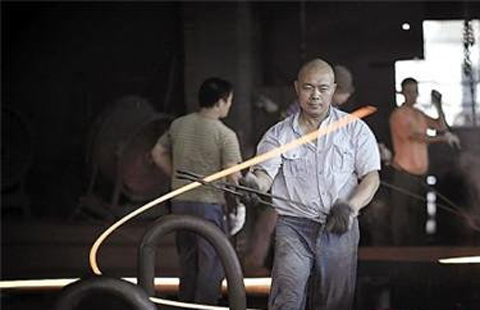
Although the economic growth has "slowed a bit," China's job market "looks pretty stable," because China's economy is transforming from a manufacturing-dominated structure to a "more services-based" one, Ma told the session, hosted by the Institute of International Finance (IIF) and focused on China's economic outlook.
Services, which are generally labor-intensive than manufacturing, became bigger than the industrial sector last year. According to Ma's recent research, the creation of urban jobs by an increase of one percentage point in the share of the services sector as of China's gross domestic product (GDP) can offset the job losses caused by a decline of 0.4 percentage point in the GDP growth.
Given that the share of the services sector in China's GDP is rising about one percentage point per year or even higher, "we're not concerned about labor market conditions," he said.
"That's the reason why the government was pretty relaxed about the GDP growth rates slowing down towards 7 percent," said David Dollar, a senior fellow at the Brookings Institution, a think tank, adding that China created about 10 million new jobs in the first eight month of this year, reaching its annual target.
Another reason for ruling out major stimulus is to "avoid further increase in leverages" in real estate, certain state-owned enterprises and local-government financial vehicles, which were already too high, Ma said.
While the real estate sector accounts for 20 percent of total investment in China and has become the main downside risk to the Chinese economy, Ma said he believes the chance of a hard landing for China's economy is very low.
Ma said the Chinese central bank has used "targeted easing measures" to support agriculture, micro-firms and public housing, and there are also new growth engines in such services sub-sectors as the Internet and heath care.
Economic indicators suggest that the Chinese economy will continue to expand at a steady pace, Zhou Xiaochuan, China's central bank governor, said at a meeting of the IMF's policy-setting committee on Saturday.
Chinese authorities will maintain consistency and stability of macroeconomic policies in order to maintain growth at a reasonable rate, promote employment and guide inflation expectations, he said.
|
 |
 |
| Less but better growth for China: IMF chief economist | China to become biggest economy by year-end |

Copyright 1995 - . All rights reserved. The content (including but not limited to text, photo, multimedia information, etc) published in this site belongs to China Daily Information Co (CDIC). Without written authorization from CDIC, such content shall not be republished or used in any form. Note: Browsers with 1024*768 or higher resolution are suggested for this site.
License for publishing multimedia online 0108263 Registration Number: 20100000002731