 |
|
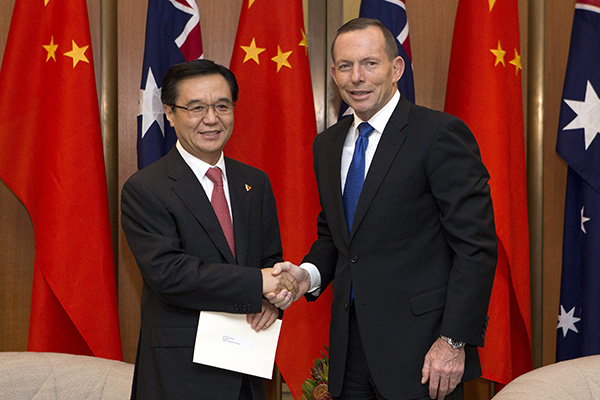
Minister of Commerce Gao Hucheng meets with Australian Prime Minister Tony Abbott during an official meeting in Canberra on Wednesday. The two countries signed a free trade agreement the same day. [Photo/Agencies] |
The landmark signing of a free trade agreement between China and Australia on Wednesday will further ensure the supply of commodities to the world's second-largest economy, helping Chinese users cut costs for materials such as coal and iron ore, industry experts said.
After more than a decade of negotiations, the two sides signed the China-Australia Free Trade Agreement, giving Chinese steel companies and power stations more choices when they need to import iron ore and thermal coal.
But the pact "will bring tougher competition to Chinese miners, which are already suffering from a weak market and falling prices", said Zhang Lin, a senior researcher at the Lange Steel Information Research Center.
Australia is the biggest iron ore supplier to China, providing about two-thirds of total demand.
According to data from the National Bureau of Statistics, China imported 71 million metric tons of iron ore in May, a 12 percent decline from the previous month and 9 percent lower than the monthly average in 2014.
"China's economic slowdown has caused lower steel demand, which resulted in declining iron ore imports," Zhang said. "It will cause worries among Australian miners because the mining industry contributes about half of the country's economic growth."
The agreement will help Australian iron ore miners sell their output on preferential terms to buyers in China, which will be beneficial to the Australian economy.
Australian coal producers will also benefit. Under the agreement, tariffs on coking coal exported from Australia to China will end, falling from 3 percent to zero immediately. The tariff on thermal coal is being phased out over two years, and there will be tariff eliminations on a wide range of Australian manufactured goods, including pharmaceutical products and vehicle engines.
For the first four months of the year, Australian coal accounted for 43.6 percent of China's total coal imports.
Compared with Indonesian coal, Australian coal is of higher quality with less sulfur, which is in line with the Chinese government's policy on environmental protection.
"Most of China's coal producers are facing sharply falling prices and weak demand, which has caused many to lose a lot of money in recent years," said Liu Dongna, a coal analyst with Shandong-based commodities consultancy Sublime China Information Group Co Ltd.

Copyright 1995 - . All rights reserved. The content (including but not limited to text, photo, multimedia information, etc) published in this site belongs to China Daily Information Co (CDIC). Without written authorization from CDIC, such content shall not be republished or used in any form. Note: Browsers with 1024*768 or higher resolution are suggested for this site.
License for publishing multimedia online 0108263 Registration Number: 130349