|
|
Lei Jun, chief executive officer of Xiaomi Corp, rides on a Ninebot at its debut in October.[Provided to China Daily] |
Late November in Beijing was chilly, misty alright but not cold enough to dampen robotics enthusiasts' passion for a major industry expo.
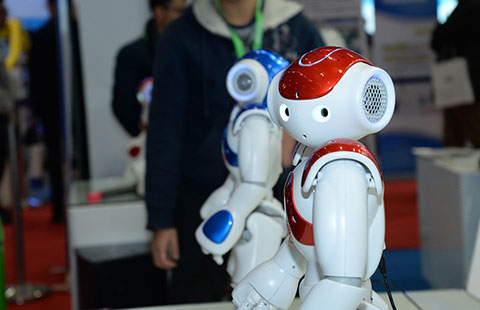
Around 50,000 of them crowded the exhibition hall as big as three soccer fields during the three-day event, jostling for a good spot to see robots playing badminton with humans, robotics arms delicately folding paper planes and auto-piloting drones hovering above head.
A life-size Iron Man performed awkward sword dance. A few meters away, a long queue formed for a five-minute tryout of Ninebot Mini, an electric, self-balancing two-wheeler equipment whose height barely reach your knees. With a single charge, it can carry a person as far as 22 kilometers at a top speed of 16 km per hour, about four times faster than an adult's walking speed.
Its maker, Ninebot Inc, which is based in Tianjin, hopes the 1,999 yuan ($312) vehicle will ignite China's personal transport market in coming months.
Ninebot's executive team has an eminent consultant to turn to for advice: Lei Jun, CEO of Xiaomi Corp, arguably China's best-known technology startup. Lei is one of the earliest investors in Ninebot.
In October, he spent half of his time at a Xiaomi product launch to introduce Ninebot's latest rollouts. "Ninebot's products aim to solve a thorny problem in big cities where many people find it hard to park their cars near their final destinations. A portable balancing device helps them complete the last kilometer transportation," Lei said at that event.
"The short-distance transportation market is one of the key areas Xiaomi is building into its ecosystem," Lei said, underlining the importance of his investment in the less than three-year-old startup.
He said Ninebot will focus on making affordable products with high quality to stimulate demand in China.
Gao Lufeng, chief executive of Ninebot, said the company controls half of China's two-wheeled balancing equipment market and the partnership with Xiaomi is set to bring its devices a wider customer base.
The operating software that can remotely control Ninebot equipment comes installed on Xiaomi smartphones. Xiaomi also features Ninebot products on its popular online shopping site.
Besides lead in the Chinese market, Gao and Ninebot have ambitious targets. In April, Ninebot made a surprise announcement that it will acquire the US-based balancing-vehicle pioneer and market leader Segway Inc at an undisclosed price. The acquisition followed an $80 million investment in Ninebot by Xiaomi, Sequoia Capital and other investors.
The acquisition of 12-year-old Segway made Ninebot one of the largest patent holders in the industry.
Gao said Segway's high-end product line, its international distribution network and top-class development team will give Ninebot an edge over rivals.
Segway, which usually introduces premium products priced as high as 80,000 yuan on Chinese e-commerce websites, will mainly feed high-end demand while Ninebot will take care of the entry-level market by making and selling sub-2,000 yuan products.

Copyright 1995 - . All rights reserved. The content (including but not limited to text, photo, multimedia information, etc) published in this site belongs to China Daily Information Co (CDIC). Without written authorization from CDIC, such content shall not be republished or used in any form. Note: Browsers with 1024*768 or higher resolution are suggested for this site.
License for publishing multimedia online 0108263 Registration Number: 130349