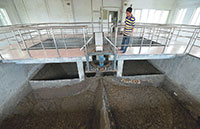
BEIJING - China finished Sunday construction on a railway to Lop Nur, a dried lake in Northwest China's Xinjiang Uygur autonomous region that is known as the "sea of death" for its high salt content.
The construction on the railway, which stretches from Hami prefecture on the China-Mongolia border to Lop Nur near China's largest desert, the Taklamakan, started two years ago with an investment of 3 billion yuan ($476 million).
The railway was co-sponsored by the Ministry of Railways, the regional government of Xinjiang and a branch of the State Development and Investment Corporation (SDIC), a state-owned investment giant that has a potassium fertilizer base in Lop Nur.
Trains will stop at nine stations before reaching Lop Nur, an area that has an estimated 500 million tonnes of potassium salt.
At the end of the railway, a cluster of buildings have been built by a SDIC subsidiary for the purpose of tapping local resources. The company already has a salt mining project that turns out 1.2 million tonnes of salt annually and works on an even larger project.
China consumes more than 10 million tonnes of potassium salt each year, 70 percent of which is imported. China's reserves total about 457 million tonnes, less than 3 percent of the world's total.
The "sea of death" also has large reserves of non-ferrous metals, including nickel, gold and copper, local authorities said.
The railway will have a freight capacity of 30 million tonnes a year and lower transportation costs by 80 yuan per tonne, the Urumqi Railway Bureau said.
Lop Nur was the largest lake in northwest China before it dried up in 1972 as a result of desertification and environmental degradation.
It once nurtured the population of Loulan, or Kroraina which was an ancient city and a pivotal stop along the well-known Silk Road but mysteriously disappeared around the third century.
Due to its geological, geographical and historical values, Lop Nur has attracted attention of scientists from home and abroad since the mid-19th century.
In 1980, Chinese scientist Peng Jiamu went missing on his fourth group expedition to Lop Nur. His whereabouts were never known.


Copyright 1995 - . All rights reserved. The content (including but not limited to text, photo, multimedia information, etc) published in this site belongs to China Daily Information Co (CDIC). Without written authorization from CDIC, such content shall not be republished or used in any form. Note: Browsers with 1024*768 or higher resolution are suggested for this site.
License for publishing multimedia online 0108263 Registration Number: 130349