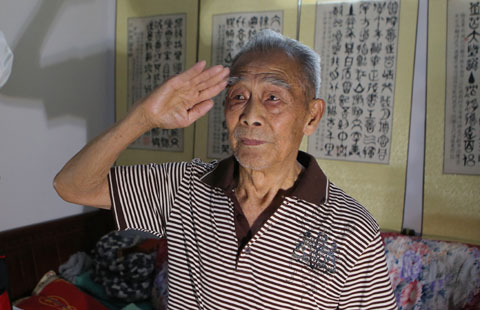
A man surnamed Shen said he felt desperate after a court in Yixing, Jiangsu province, refused his request to inherit four frozen embryos that belonged to his dead son and daughter-in-law.
Shen, who is in his 50s and requested that only his last name be revealed, lost his only child and daughter-in-law in a car accident on March 20, 2013. His daughter-in-law, surnamed Liu, who also was the only child of her family, planned to have the embryos implanted five days later in Nanjing, capital of the province.
The lawsuit against Nanjing Drum Tower Hospital, which arose from its reluctance to transfer the frozen embryos, went to court on Thursday.
To gain control of the embryos, Shen and his wife had also sued the parents of their daughter-in-law.
Both cases were combined into the one case tried on Thursday.
"The embryos have the possibility to grow into a human being, thus cannot be considered as an ordinary object that can be transferred or inherited," said Lu Yaqin, the judge for the case.
"Also, the embryos can only be used by the couple to have babies and cannot be donated or sold according to Chinese laws," Lu said. "Since the couple are dead, the embryos can no longer be implanted."
"The only way to keep the embryos alive after removing them from liquid nitrogen at the temperature of -196 C is to have them implanted into a surrogate mother, but that is against the law in China," said Zheng Zhelan, the hospital's lawyer.
"Surrogate motherhood brings a lot of ethical issues, including who is the real mother and who should be responsible for babies with congenital disabilities," Zheng said.
"It is considered a renting or selling of an organ in China."
Zheng added that the transfer of sperm, eggs and embryos between hospitals also is forbidden in China.
In 2001, China's health ministry issued a regulation on assisted fertility techniques that banned both commercial and altruistic surrogacy.
Except for some countries, such as India and Israel, commercial surrogacy is banned in most countries and regions in the world.
"Nanjing Drum Tower Hospital has the ability to preserve the embryos for years, but the couple had signed a document in September 2012 that the embryos could be destroyed one year later," Zheng said. However, destruction of the embryos was put off pending the outcome of the case.
"Though we also feel sorry for the elders, we cannot violate the country's laws and regulations," Zheng said.
Guo Wei, the plaintiffs' lawyer, said that no specific law in China forbids the inheritance of frozen embryos.
"So far, there have been no regulations or laws concerning this matter in China. We hope that the court can consider the special condition and comfort the four heartbroken parents," Guo said.
Shen said he will appeal to a higher court to get the embryos.
"We can wait until the country ends its surrogacy ban," said Shen. "Those embryos are our only hope, and we cannot lose them."
Contact the writers at cangwei@chinadaily.com.cn and songwenwei@chinadaily.com.cn


Copyright 1995 - . All rights reserved. The content (including but not limited to text, photo, multimedia information, etc) published in this site belongs to China Daily Information Co (CDIC). Without written authorization from CDIC, such content shall not be republished or used in any form. Note: Browsers with 1024*768 or higher resolution are suggested for this site.
License for publishing multimedia online 0108263 Registration Number: 130349