


Tibetan man repairs old books to save precious texts









LHASA — At Truzing Palace of Norbulingka, a world heritage site in Southwest China's Tibet autonomous region, thousands of ancient books featuring various themes are stored on shelves. All the old books are preserved by a unique binding technique using two wooden clamping planks wrapped in pieces of cloth.
Gyumey Tsultrim, 56, with Norbulingka's management office, was busy carefully carrying the unregistered books to the studio of his ancient book survey team nearby. For now, the team's priority is to make an inventory of the ancient books, both manually and digitally, for the specific identification of the documents.
Some of the books are even made of palm leaves.
Gyumey Tsultrim has been engaged in the region's ancient book preservation cause for 25 years and was deeply impressed by the great difficulty of collecting and restoring palm-leaf manuscripts of Buddhist sutras.
The Buddhist sutras written on tailored palm leaves are a primary source for the study of ancient Tibetan culture. Seeming fragile, they are well-preserved in Tibet thanks to the region's dry climate and unique preservation methods.
At present, there are over 1,000 Sanskrit palm-leaf Buddhist sutras, totaling nearly 60,000 leaves in Tibet, which account for 60 to 80 percent of the total surviving palm-leaf manuscripts of Buddhist sutras.
Gyumey Tsultrim, who graduated from the High-level Tibetan Buddhism College of China, has studied Sanskrit for years. He began participating specifically in the collection, restoration and protection work of the palm-leaf Buddhist sutras as early as 2006.
In the following six years, the region's palm-leaf Buddhist sutras preservation team traveled a total of 17,000 kilometers across the region, visiting temples, ruins and households for the collection of such ancient books.
Tsewang Junmen, office director of the regional leading group on palm-leaf Buddhist sutras protection, recalls that many temples were tucked away in deep mountains, with bumpy roads that also became muddy when it rained, making their collecting work extremely hard. Once, the survey team ran into a power outage at a temple and the staff could only record the texts by relying on natural light in the daytime.
"The palm-leaf Buddhist sutras, mostly written in Sanskrit, are quite illegible and need cross-reference via other documents to further identify their contents. I have to recognize the characters one by one. One single mistake in characters can totally change the meaning, so it takes a long time to sort out the relics of the texts," says Gyumey Tsultrim.
"Some palm-leaf Buddhist sutras have already become moldy, worm-eaten or even rotten due to considerable age, multiplying the difficulty of their restoration," he adds.
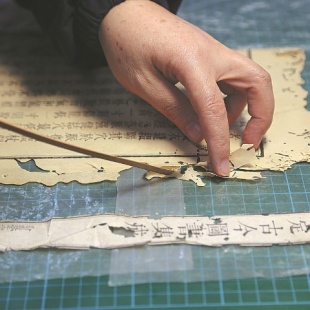
The patient craftsman would boil local sesame and flour into a natural adhesive to repair the Buddhist sutras instead of merely relying on sewing. The palm-leaf pages, thus, can be opened again, with some clean water applied to their surfaces, and become less prone to damage after his repair.
Previously, none of Tibet's cultural heritage protection units had any equipment for cultural relics protection and scientific research worth more than 100,000 yuan ($14,280). All the protection units in the whole region shared one tech laboratory and one relic restoration room.
However, in 2013, Tibet launched a project, adopting scientific and technological means, to better preserve its cultural relics. Tibet's majestic Potala Palace, Norbulingka, the regional museum and the like thus began to use tailored storage cabinets and environment monitoring equipment to protect the old texts.
Gyumey Tsultrim now also teaches Tibetan calligraphy and knowledge of the ancient texts for free to more than 600 students across the region. Some of his students have become teachers and new inheritors of local cultures in Tibet.
"Cultural heritages preserved by our ancestors through wisdom, diligence and hard work should be inherited, protected and carried forward in our modern, civilized society," he explains.