



Rural tourism helps Bijie bloom









Cooperatives organize at least five training sessions a year for farmers like Zhao, to equip them with the skills they need for their new lifestyles, and are constantly improving management and services.
Xiao Tianyao, 92, from Luzhou, Sichuan province, stayed with her daughter in the Baili zone from more than a month over the summer. She told Bijie Daily, "I didn't anticipate finding a perfect combination of cool weather, fresh air, beautiful scenery, modern facilities, considerate services and hospitable people in such a remote, inland, mountainous area as Bijie."
She added that she hopes to return to the area every summer.
During a recent inspection of the zone, Zhou Jiankun, Bijie's Party secretary, called on local officials to further improve public services, particularly in healthcare, education, infrastructure and hygiene.
Experts said the seamless convergence of management experience, capital, land and labor resources are the key factor that has helped increase farmers' incomes and raised agricultural output efficiency.
Companies and cooperatives are making joint efforts to extend the industrial chain of rural tourism by building workshops to process and produce agricultural products and tourist commodities, such as silk azaleas, traditional outfits and specialty foods.
Authorities have paid special attention to protecting and industrializing local culture. Fuyuan village, for example, was one of the first to be distinguished for its ethnic characteristics, while the Yi ethnic group's floral sacrifice ceremony has been recognized as Bijie's intangible cultural heritage, and traditional torch festival has become a major tourist draw.
Thanks to effects of rural tourism on poverty relief, the Baili zone was named one of China's 280 tourism poverty alleviation demonstration projects.
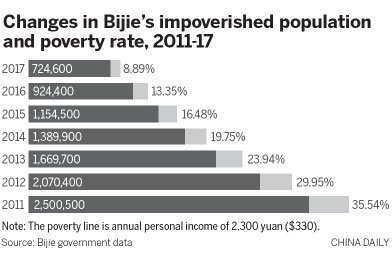
The zone is only one example of Bijie's poverty alleviation endeavors. Since 1988, when the State Council earmarked the city as a national poverty alleviation experimental area, Bijie's impoverished population has shrunk by 5.94 million (about 700,000 people still live below the poverty line), and the poverty rate has dropped from 65.1 percent to 8.89 percent.
In Bijie, the average personal disposable income in rural areas has risen from 182 yuan per year in 1987 to 8,473 yuan per year in 2017. Meanwhile, GDP has increased by 103 times.
Contact the writers at liyang@chinadaily.com.cn





