



Maotai recycles grains to stay green in liquor production









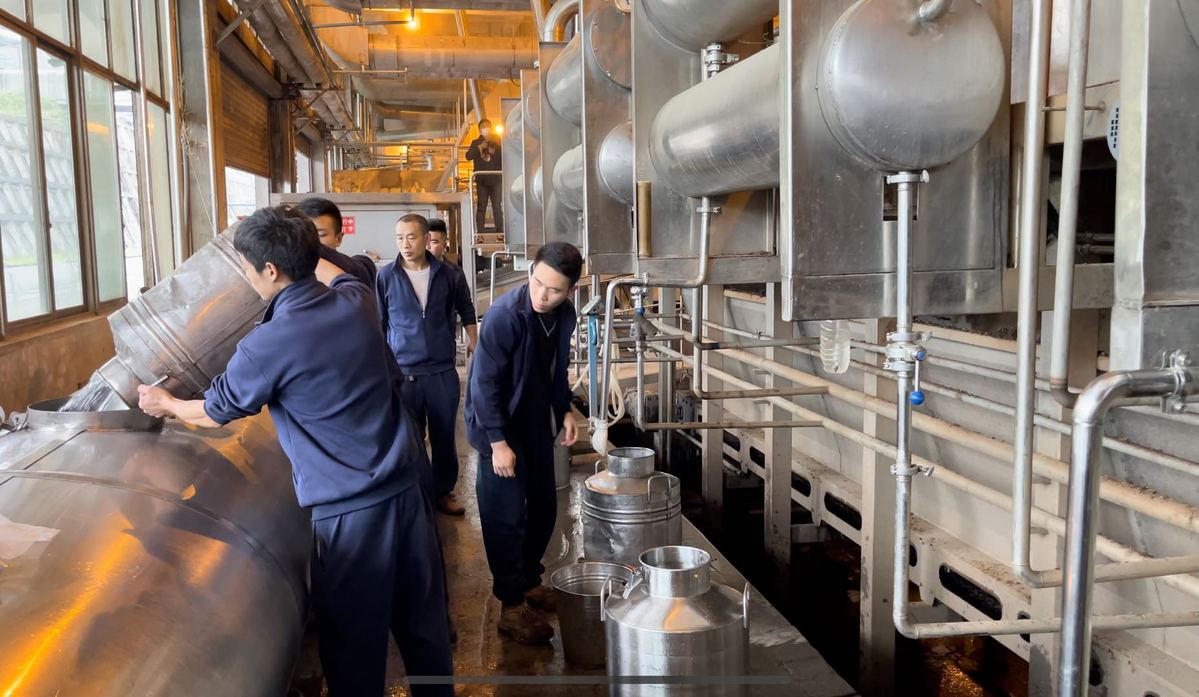
Kweichow Moutai Co Ltd, China's leading high-end liquor maker in Maotai town in Southwest China's Guizhou province, is speeding up green development under the country's energy efficiency and carbon intensity targets.
"The distillation process in baijiu (Chinese white liquor) production will produce a cereal byproduct called distillers grains, which is a mix of organic waste like corn, rice and various kind of microorganisms. If they are handled in an improper way, such as being put in landfills, they will cause pollution to the surrounding environment," said Zhou Xiaonong, general manager of Guizhou Moutai Brewery (Group) Circular Economy Industrial Investment Development Co Ltd, a subsidiary of Kweichow Moutai that focuses on recycling distillers grains.
According to Zhou, Moutai produces about over 100,000 metric tons of distillers grains each year. To better recycle the organic waste, Guizhou Moutai Brewery (Group) founded a circular economy industrial park in 2013 with total investment of about 3 billion yuan ($462 million), taking up about 3,700-mu (246.67 hectares) of land.
"Distillers grains are produced after 9 cycles of steaming Baijiu raw materials and 7 processes of liquor production. When the distillers grains come to the industrial park, we add new sorghums and herbs, which allows us to produce another two rounds of Baiju of relatively good quality," Zhou said.
Aside from producing Baijiu, distillers grains can also the raw material of biogas, which is used to generate electricity and heat for the industrial park as well as neighboring villages, Zhou said.
After recycling, the residue of distillers grains can be further processed into organic fertilizers. "Over 75 percent of the residue of distillers grains are organic matters, much higher than the 40 percent standard set by the nation. Those organic matters can effectively improve soil quality," Zhou said.
To date, the industrial park can recycle up to 350,000 tons of distillers grains per year. Those grains can be further processed and produce about 15,000 tons of baijiu, 10 million cubic meters of biogas, 120,000 tons of organic fertilizer and 20,000 tons of fodder.
"Going forward, the industrial park will undertake a series of attempts to repurpose the grains, such as using them to produce makeup and healthcare products. China's energy efficiency and carbon intensity targets have no doubt offered great potential for growth for green industries," Zhou said.
China plans to reduce energy consumption per unit of GDP by 13.5 percent and carbon dioxide emissions per unit of GDP by 18 percent in the 14th Five-Year Plan period (2021-25), Premier Li Keqiang said in March.



















