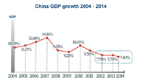
According to the International Monetary Fund, China's gross domestic product (GDP) is projected to increase to $17.6 trillion this year, if calculated at purchasing power parity (PPP), whereas the United States' is expected to grow to $17.4 trillion. In reality, China has not yet overtaken the US as the world's largest economy.
To compare the economies of different countries, you need data. That data, in turn, is reported by each country in its own currency, which must be converted into a common currency (usually in US dollars). There are two main methods for this conversion.
One method relies on market exchange rates - that is, the rates in the foreign exchange market. As every international tourist knows, foreign destinations exchange money only on the basis of hard cash.
The other method relies on the PPP exchange rate - that is, the rate at which the currency of a country would have to be converted for a purchase in another country. After all, non-traded goods and services tend to be cheaper in low-income countries than in high-income ones. For example, a haircut is cheaper in Shanghai than in New York.
In advanced economies, the difference between market rate and exchange rate measurements is significant, but not huge. In emerging economies, it is typically both significant and huge.
Measured by the market-exchange rate, the US economy was $16.2 trillion in 2013. If the PPP is used, it was close to $17.6 trillion. Based on the market exchange rate, the Chinese economy was less than $8.4 trillion, but if the PPP is used, it was nearly $16.2 trillion - almost twice as large.
Based on market rates, the Chinese economy remains 55-60 percent relative to the US GDP. So China will overtake the US in these terms, but by the 2020s - not yet.
If the PPP concept were applied to compare entire economies, then India would already be the world's third-richest nation having overtaken Germany in 2003 and Japan in 2008. The Indonesian economy would be larger than that of the United Kingdom and the Philippines economy would be bigger than Switzerland's.
If, however, you rely on GDP comparisons that are based on market exchange rates, India is the tenth-largest economy and will need years to overtake the US. By the same token, the Indonesian economy is about one-third of the UK economy, whereas the Swiss economy is 2.5 times bigger than that of the Philippines.
Huge gaps remain between the living standards in the advanced and emerging economies. Measured by per capita GDP (PPP), living standards in the UK are nearly four times higher relative to Indonesia, while living standards in Switzerland are more than eight times higher than those in the Philippines.


Copyright 1995 - . All rights reserved. The content (including but not limited to text, photo, multimedia information, etc) published in this site belongs to China Daily Information Co (CDIC). Without written authorization from CDIC, such content shall not be republished or used in any form. Note: Browsers with 1024*768 or higher resolution are suggested for this site.
License for publishing multimedia online 0108263 Registration Number: 130349