 |
|
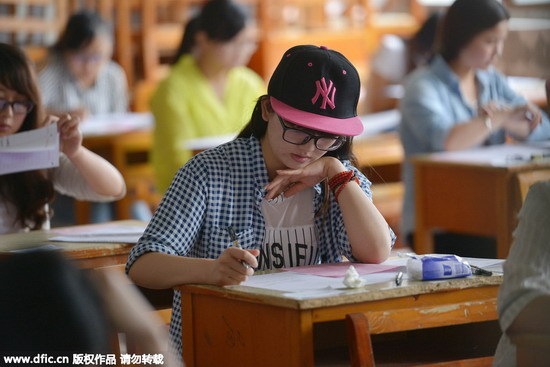
Chinese students take part in the first examination of the national college entrance exam, also known as gaokao, at a school in Guiyang city, southwest China's Guizhou province, on June 7, 2014. [Photo/IC] |
Are Chinese students seeking to escape from the national college entrance exam?
It's reported that about 9.5 million students took part in the national college entrance exam, or gaokao, in 2015, down from 10.5 million in 2008.
The shrinking number of students sitting the exam partly reflects the demographic change caused by the one-child policy in the past three decades.
But there is also a growing number of Chinese students studying overseas. According to official statistics, about 500,000 Chinese students studied abroad last year, with the number of Chinese students studying in the United States doubling to 300,000.
Unlike the Chinese higher education enrolment system, developed countries' testing of children offers a more comprehensive evaluation of their abilities.
In recent years, the Chinese education authorities have been promoting education reform, but reform is still needed in higher education enrolment. The most important point is to make sure who is the examiner of the nation-wide exam. The original diversity was intended as a filter to ensure a diverse talent pool. The current situation is, carried out by the government as solo examiner, with a single type of exam supposed to determine a wide variety of talents. With this in mind, children and their parents who believe the exam may not identify their talents and studying for it will not broaden their abilities, may choose to study elsewhere if that is a viable option for them. This is an important reason why parents send their children abroad.
The basic characteristics of foreign enrolment are determined by the final decision on the candidates' performance in self-expression.
While the implementation of this kind of system is expected to be applied in China at some point in the future, the authorities should in the meantime improve the college entrance examination procedure by allowing space for students to discover themselves.
At present, teachers or professors offer specific knowledge which is built around standard answers. This has resulted in the uniformity of students, and only allows them to find their own weaknesses rather than their strengths.
This is the opposite of education systems in developed countries, which stresses more on inspiring and encouraging students, so that in the course of teaching, students are strengthened by discovering their inherent abilities and advantages.
As for the role of employers, they should be introduced into the education system even before they look at any qualifications and resumes of students. The preference of employers for the students of top universities is a global preference, but the difference is Chinese employers pay more attention to graduation certificates, thus Chinese employers contribute to nurturing the culture of the current education system, which is focused on the national college entrance exam.
Professional third-party evaluators should make objective assessments of students that serve as the basis for applying to a college or workplace.
Chu Zhaohui is a senior researcher at the National Institute of Education Sciences. The article is an excerpt of his interview with China Daily's Zhang Yuchen.


I’ve lived in China for quite a considerable time including my graduate school years, travelled and worked in a few cities and still choose my destination taking into consideration the density of smog or PM2.5 particulate matter in the region.
Copyright 1995 - . All rights reserved. The content (including but not limited to text, photo, multimedia information, etc) published in this site belongs to China Daily Information Co (CDIC). Without written authorization from CDIC, such content shall not be republished or used in any form. Note: Browsers with 1024*768 or higher resolution are suggested for this site.
License for publishing multimedia online 0108263 Registration Number: 130349 



