



More steps needed to curb plastic bags









Regulation meant to encourage people to reduce their use has proved ineffective because it fails to target their production as well
June 1 marked the ninth anniversary of the national ban on free plastic carrier bags. The national regulation that came into effect on June 1, 2008, forbids all supermarkets and shops from providing plastic bags for free to customers.
However, a recent People's Daily report says the ban has failed to achieve the expected results, as small shops continue to provide plastic bags for free. As for supermarkets, they do charge customers for bags, but there is no data indicating their use has been curbed. The only difference the regulation has made is that supermarkets make additional money by carrier bags.
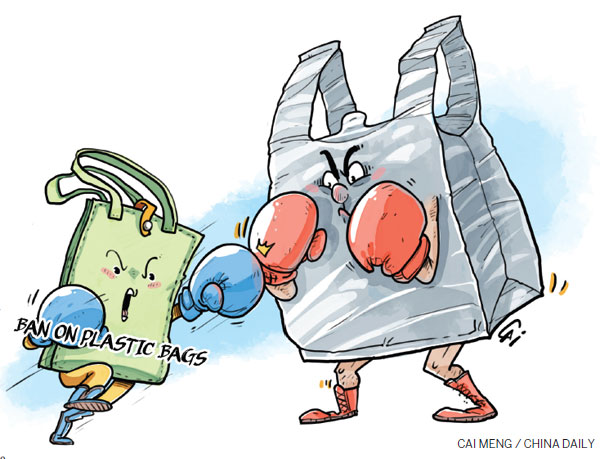
The plastic bags we use daily are made of polyethylene, which in turn is made mainly from petroleum products. These bags pollute the environment, especially soil and water, as they take about 200 years to decompose naturally.
The government issued the regulation to encourage people to use fewer plastic bags, so as to save petroleum resources and protect the environment. But it has not fulfilled its purpose.
Data show that people in China use more than 60 million metric tons of plastic materials every year, while the total amount for the whole world is about 400 million tons, which goes against the modern concept of ecological conservation. Worse, the ineffectiveness of the regulation has hurt the credibility of the legal system.
The regulation to curb the use of plastic carrier bags has proved ineffective because it targets one aspect of a bi-dimensional problem. What also needs to be curbed is the production of plastic bags that do not meet environmental standards, which will reduce their supply as well.
Currently, the production cost of plastic bags is as low as 0.1 yuan (1 cent; .01 euro; 1p) per piece, which is very cheap. Perhaps the government should impose more tax and fees on enterprises producing plastic bags, in order to increase their cost and deter shopkeepers from giving them for free, and thus reduce their usage.
Another factor that demands attention is the lack of substitutes for plastic bags. For many people, a plastic bag is still the most convenient choice when it comes to carrying their groceries and other products from supermarkets.
This multifaceted problem cannot be dealt with by the government alone. While the government should take measures to strengthen the recycling economy and recycle the most plastic bags in use, people have to learn to sort the garbage they produce every day so that waste management facilities and businesses can easily separate the recyclable waste to turn it into resources again.
Of course, government departments have to teach residents the importance of sorting garbage at source, because that has become absolutely necessary to protect the environment. People should also be made to understand that avoiding using plastic bags could make a difference to the state in which we leave the planet for our children.
The problem of plastic bags is not only related to social governance, but also to our idea about modern society. As such, the government must take multiple measures to make the ban on plastic bags truly effective, and reverse the current polluting trend, which will not only help protect the environment but also restore the credibility of the legal system.
This article first appeared in hebnews.com. The views do not necessarily reflect those of China Daily.
(China Daily European Weekly 06/23/2017 page11)


Today's Top News
- Kite fans from all over swoop in for a flying visit
- Japan's easing of weapons export restrictions opposed
- Harmonious growth model nurtured
- Travel demand for Japan slumps amid strained ties
- UN urges freedom of navigation in Hormuz
- Smearing speaks more about the smearer: China Daily editorial





