



Growth rate of private wealth sees big increase









Riding on the growth of China's economy, the number of people in the nation with at least 10 million yuan ($1.46 million; 1.3 million euros; £1.15 million) in investable assets has expanded more than eightfold within just a decade to about 1.58 million in 2016.
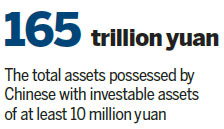
Correspondingly, the total assets they possess has increased more than sixfold from 26 trillion yuan in 2006 to 165 trillion yuan in 2016, around twice the size of China's 2016 gross national income.
Although China's economic growth has slowed, the growth rate of the private wealth market has not weakened, but has expanded robustly at an average annual rate of 23 percent from 2014 to 2016. This compares with average annual growth of 21 percent from 2006 to 2016, after China launched a cycle of interest rate and reserve requirement ratio cuts in 2014, leading to a large-scale recovery in the residential market, according to the latest research report jointly released by China Merchants Bank and Bain & Co.
"The private wealth market will continue double-digit growth in the coming years, but the pace will be slower, as the authorities have tightened regulations on the property market to rein in skyrocketing home prices. We forecast 14 percent growth in the total investable assets of wealthy people in 2017 to 188 trillion yuan," says Wang Jing, general manager of the private banking department of China Merchants Bank.
Apart from the huge increase in the size of the private wealth market, the report also found that these wealthy people have become more diverse in their investment goals, outbound investment destinations and geographical location.
China's rich people are now more conservative in terms of taking investment risks. According to the report, more of them are opting for "wealth preservation" and "inheritance" as their major wealth targets, instead of "wealth creation", which was their focus in 2009, reflecting changes in needs and values.
In terms of overseas investment destinations, China's wealthy are more rational about overseas asset allocation, as they have increasingly diversified their investments in Australia, Canada and Singapore in the past two years, while decreasing the proportion invested in traditional outbound investment destinations like the United States.
The percentage of high net worth individuals surveyed with overseas assets has increased from 19 percent in 2001 to 56 percent in 2017, but the overall percentage of assets allocated overseas has leveled off, statistics showed.
Although most rich people are still in eastern coastal areas such as Shanghai, Jiangsu and Zhejiang, the geographical distribution of wealthy people has increasingly penetrated central and western regions since 2008.
"It's clear from the research that China's wealthy are incredibly diverse, have a multitude of needs and that their priorities are starting to shift," says Jennifer Zeng Li-chun, a partner at Bain & Co and co-author of the report.
cherrylin@chinadailyhk.com
(China Daily European Weekly 06/30/2017 page29)


Today's Top News
- Kite fans from all over swoop in for a flying visit
- Japan's easing of weapons export restrictions opposed
- Harmonious growth model nurtured
- Travel demand for Japan slumps amid strained ties
- UN urges freedom of navigation in Hormuz
- Smearing speaks more about the smearer: China Daily editorial





