With the rise of Lu Xun and several contemporaries, prose became a reality, and a new generation of fiction writers emerged. Lu Xun was not just writing in a new voice, but daring to record the voices and speech he heard around him.
Lu Xun is thus recognized as one of China’s first “modern” writers, and his focus on dissonance and alienation, and questions of existence as they overlapped with politics, were radically new.
But in order to see the world out of which Lu Xun was writing, and the traditions which he was negotiating, it seemed important to experience the very space in which he grew up. In what domestic world did Lu Xun live, and did his career in part come as a reaction to that? Could one sense the very same world Xun talked about in his prose, or had it morphed into something unrecognizable?
I headed last week with a few fellow researchers to Lu XunGuli, or the ancient roads and houses where Lu Xun grew up and studied, located in the center of Shaoxing. Lu Xun’s own family home was built in the Qing Dynasty, and it’s surrounded by canals where tourists can hire gondolas, and choudofu vendors call out their best prices. We arrived an hour before a thunderstorm rolled through Shaoxing, which created a dense fog and frenzy to move through the house, as many hustled to avoid the coming rain.
Yet even amid the tourist rush, one has the visceral sense that this was a writer who not only existed on a hinge between two radically different worlds, but also had to work tirelessly to create such a "modern" literary space.
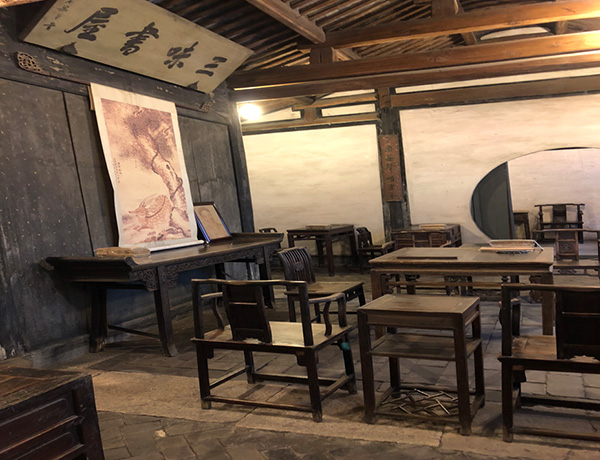
The building in which he attended classes each morning are imbedded with signs of tradition; rows of desks where members of the Zhou (Lu Xun is a pen-name; his original last name is Zhou) family studied together, a hierarchical system of office study arrangement (with the Master and Lu Xun's tutor, ShouJingwu, holding a study and bedroom attached by a private corridor), and a series of canals and gardens that evoke classical literary lifestyles. There’s also the sanwei study, or the study of "three flavors", a reference to the richness that thinkers such as Confucius believed would emerge through diligent reading. Lu Xun’s early education reflected that history—he was trained in Confucian classics and traditional poetry.