



An ancient thoroughfare sleeps below the soil









'Cooked soil'
The ridge of the Ziwu Range is generally even, and the builders tried their best to make the slopes gentle, the road straight and its surface sturdy.
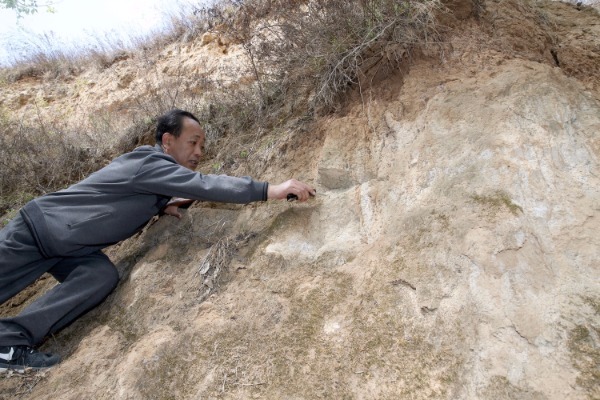
It is said that the mixture used to construct the roadbed included gravel and large amounts of "cooked soil" - earth heated to a high temperature, partly to kill off all flora and fauna - with rice milk used to glue it all together.
Stone rollers were then used to make the road surface even and compact. To prevent landslides, the builders paid special attention to reinforcing the roadbed and the slopes, and they employed s-bends to minimize the gradient during ascents and descents.
Where the Ziwu Range ends at the northern border of the Loess Plateau, the road continues through the Erdos Plateau, the Kubuqi Desert and the Hetao Plain, and meets a fortress affiliated to the Great Wall at the foot of the Yinshan Range in Inner Mongolia.
"Basically, the Qinzhidao is like an expressway, although primarily for military use, in the modern sense," said Ren Baojun, a photographer in Chunhua who has been taking photos of the ruins along the road for many years.
"Whenever I walk on it, I am astonished by the perseverance and skill of the Qin people. It is hard to imagine how they finished all of this with just manpower and livestock," he said.
Wang Zijin, a historian who specializes in studies of the Qin and Han dynasties at Renmin University of China in Beijing, said that as it overlooks the valley on either side of the Ziwu Range - the main route for invaders from the north - the road could serve as a defensive fortification for Xianyang, in the event of enemy forces breaching the Great Wall.
The road played an important role in maintaining the stability of the north during the Han Dynasty, giving potential invaders cause to think twice because of the ruler's ability to send quick-response forces via the road.
Wang said: "The Great Wall is like a shield, while the Straight Road is like a spear. And if the Great Wall is a bow, the Straight Road is an arrow."
According to He Yiping, curator of the museum of Xunyi county, Shaanxi, the Qinzhidao was used at least twice in the Han Dynasty and the Tang Dynasty (618-907) to help transport large numbers of troops from Central China to fight against invaders from the north.
He Yiping often arranges for people interested in the Qinzhidao to hike along the ancient road. "Not many people have walked on the road over the past few decades, which has helped to protect it. The ancient ditches, tombs and smoke towers are largely well protected, hidden in grasses and forests," He said.




















