


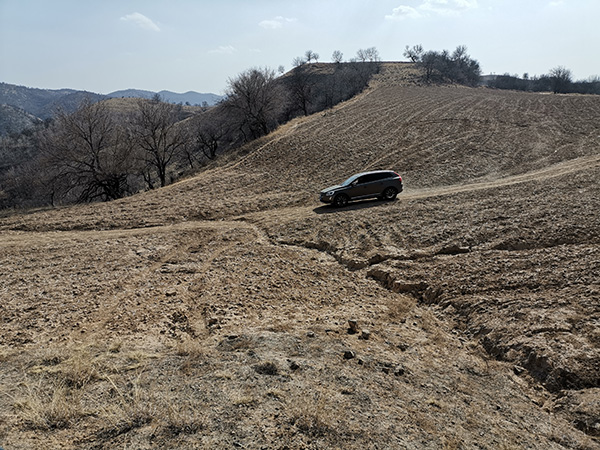
An enduring puzzle
It remains a puzzle how Meng and Fu could complete so much in just two years. Despite the road being unfinished, it only took about three days for the Qin army and its supplies to reach the north, as opposed to two weeks in the days before the highway existed.
Zhang Haibin, a researcher at the Cultural Relics Administrative Department of the Baotou government, said the road allowed large numbers of people from the south to settle on the Hetao Plain, increasing the leverage of the Han people in a region where the Mongolian and Hui ethnic groups previously dominated.
The road was in use until the end of the Qing Dynasty (1644-1911). Over the course of more than 2,000 years, it served as a transportation artery for commercial, cultural and religious exchanges between Han farmers in the south and the nomadic peoples of the north.
Wang Junmin, a farmer in Liangwudi village, the road's starting point, said: "Although the Qinzhidao is largely deserted nowadays, it is still alive in the lives of the local residents. Many of our houses and yards were built with ancient bricks and tiles found near it. They are of good quality and are ideal building materials, even today."
Liu Hulin, a painter and chairman of the Ganquan county Federation of Literary and Art Circles who has been inspired by many trips along the ancient road, said: "Farmers have lived near the Qinzhidao for generations, and their lifestyle, construction technologies and even language are unique. For instance, the way they build a house and courtyard, and some of their vernacular language can be traced to the Qin and Han dynasties."
Archaeologists were not really aware of the road until 1962, when a national newspaper published a local reporter's essay on the subject.
In the mid-1970s and late 1980s, a number of archaeologists, historians and artists organized field research tours along what remained of the road. Their findings largely accorded with Sima Qian's records and confirmed the existence and the main route of the legendary thoroughfare.
Zhang Zaiming, an archaeologist with the Shaanxi Academy of Archaeology, told China Central Television: "These (the findings) are apparently not enough to highlight the importance of the road. Academically, it takes more concrete and professional archaeological findings, which would be complicated and costly, to match the Qinzhidao with its status in history."
In the 1990s and the first decade of this century, Shaanxi, Gansu and Inner Mongolia - the three provincial-level regions the road traverses - put certain sections of the Qinzhidao within their jurisdictions under government protection, and turned some into tourist attractions.
Despite those moves, much of the once-busy road remains asleep under the grass, largely unknown to most people.





