


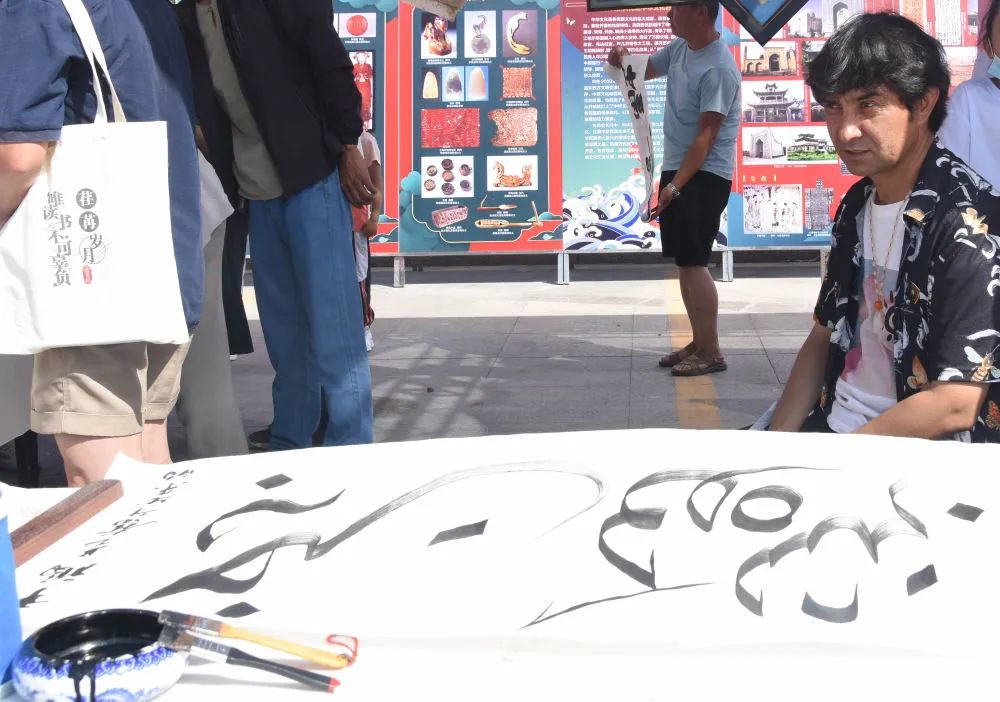
URUMQI - Amid dynamic music and Uygur dancing, Kurbanjan Rouzi picked up a special brush pen and wrote in the Uygur language on rice paper at the east gate of the ancient city of Kashgar in Northwest China's Xinjiang Uygur autonomous region.
Yang Yongcai, a local calligrapher of Chinese characters standing beside him, wrote the corresponding translation in Chinese characters: Happiness comes from hard work.
Many tourists gathered to take photos while an internet celebrity livestreamed the event.
Kashgar held a series of intangible cultural activities for Uygur and other ethnic groups in its ancient city's scenic area recently.
Chen Rong, a tourist from Yunnan province, says that she only knew that the Uygur music, dance and costumes were distinctive, but had little idea that the Uygur calligraphy was so beautiful.
Kurbanjan, 53, has studied Uygur calligraphy for more than 30 years. His works have been exhibited in the Ethnic Library of China in Beijing.
What he remembered most was that, when he went to Shenzhen University in Guangdong province for an exhibition, many college students asked him about the details of Uygur calligraphy.
"It is the same as Chinese characters. The beauty conveyed is loved by everyone," the Uygur calligrapher says.
"In the past, ethnic families liked to hang carpets at home. Now, many families hang calligraphy works instead," he says, smiling.
Kurbanjan was identified as an inheritor of the intangible cultural heritage of Uygur calligraphy in 2014.
He wrote a big Chinese character, fu ("happiness" in English), on a piece of traditional mulberry paper and then wrote four small fu in four different Uygur calligraphy styles around it.
With more exchanges over the past two years with calligraphers that are specialized in Chinese characters, Kurbanjan gradually began to practice and study Chinese calligraphy. The locals love his works that feature two languages written on a single piece of paper.
In Xinjiang, the local government has been promoting the standard spoken and written Chinese language while effectively protecting the right of ethnic groups to learn and use their own languages.
Holding such activities in Kashgar can enable more tourists to better understand the Uygur culture and the richness and long history of the Chinese culture, Kurbanjan says.





