Carving out a symbol of virtue
Craftsmen deploy their skill and experience accumulated over the centuries to help shape jade's continuing appeal, Fang Aiqing reports.










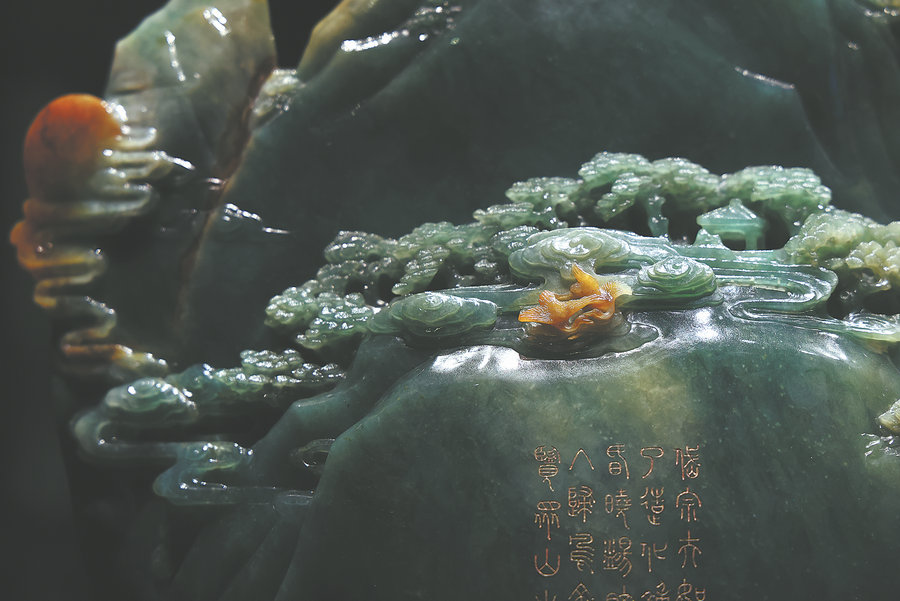
Manual work
In the past, jade carving was much more labor-consuming. Artisans had to sit for a long time at a table-like iron rotary machine with cutter bars.
Summer or winter, they treadled to drive the machine while picking up abrasive sands — usually made from quartz or garnet — from a tray of water.
It was largely by this machine they cut, carved, drilled and polished to create miracles on the tough mineral that has long been favored by the Chinese.
Since the 1960s, motor-powered rotary machines have been introduced to the industry, along with improved tools such as various grinding heads, cutters, ultrasonic drilling equipment, mechanized grinding beads and vibratory polishers, Wang Mingying and Shi Guanghai, both from the China University of Geosciences in Beijing, wrote in a 2020 article on the evolution of Chinese jade-carving craftsmanship.
According to them, computer numerical control and three-dimensional scanning devices have been increasingly applied in jade carving. However, detailed manual work, such as that used to make eggshell-thin jade vessels, as well as the above-mentioned qiaose and chain carving techniques, cannot be achieved with these machines.
Yang Xi, a Suzhou-based national-level intangible cultural heritage inheritor of jade carving, has observed this trend. He says it's quite usual for the younger generation to complete the majority of work with a computer and then continue the carving and polishing by hand.
He admits that sometimes even industry insiders cannot tell whether artworks are made by hand or with the assistance of machines.
However, the 60-year-old veteran carver sticks to the traditional manual craft and particularly emphasizes the importance and challenge of originality in design.
Yang Xi is well-known for his series of works inspired by his hometown, a water town with the typical Jiangnan (the region south of the lower reaches of the Yangtze River) temperament.
He has also created various works in which he has inserted new expressions into the antique craftsmanship, such as incorporating an internal structure of a mechanical watch into a piece of work — a rare theme in jade carving — and an innovative adaptation of the Avalokiteshvara Bodhisattva (Thousand-Hand Bodhisattva).
"The art should always keep pace with the times," he says.